
When Australia flicked the switch on the world’s first nationwide ban on social media for under-16s, it didn’t just trigger a collective gasp across Silicon Valley – it sent a ripple through Westminster. Suddenly, a policy that once sounded unthinkable moved from fringe idea to dinner-table debate. And this week, the UK government turned the volume up.
A late-night update from GOV.UK on 19 January 2026 announced a sweeping consultation on children’s use of technology, tougher enforcement of phone-free schools, and – crucially – an explicit look at whether a social media ban for children could work here. Ministers will even visit Australia to see the system up close. For a country that helped pioneer online safety law, this is a pivot moment: from content moderation to design intervention; from “be safe online” to “don’t be online at all – at least not yet.”
The UK’s new posture: phone-free by default, safety by design
The announcement is broad, ambitious – and unambiguously political. The government says it wants to “drive action to improve children’s relationship with mobile phones and social media,” launching a national conversation with parents and young people while tightening the screws on schools and platforms alike.
Immediate action starts at the school gate. Ofsted inspectors will now check mobile phone bans at every inspection, with clearer guidance that schools should be phone-free environments – not just in lessons, but at break times, lunch and between classes. This is about modelling behaviour, too: teachers are expected not to use personal phones in front of pupils, reinforcing that devices are “not necessary in the classroom.”
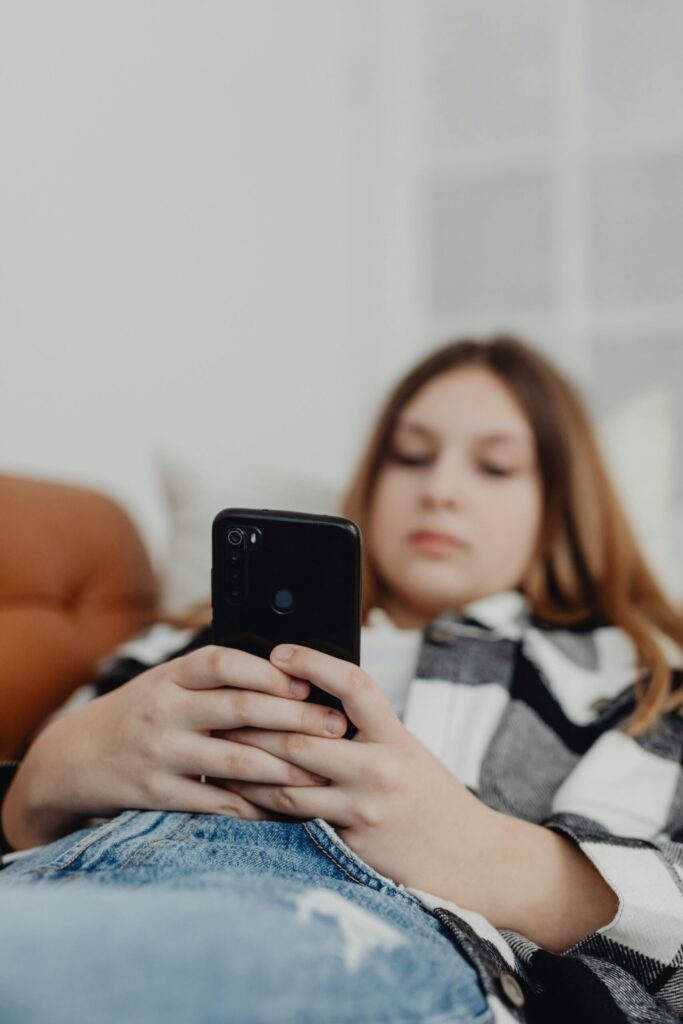
Infinite scroll, finite childhood? Screen addiction sits at the heart of growing concerns around children’s mental health, and proposed under-16 social media bans in the UK and Australia.
Credit: Karolina Grabowska / Pexels
Why the urgency? Despite near-universal policies – 99.9% of primary schools and 90% of secondaries already have them – 58% of secondary pupils report phones being used without permission in lessons, rising to 65% among Key Stage 4. Policy exists; practice lags.
Beyond schools, the consultation goes straight to the heart of the platforms. It will explore “determining the right minimum age for children to access social media,” “improving the accuracy of age assurance,” “assessing whether the current digital age of consent is too low,” and – perhaps most interestingly – “removing or limiting functionalities which drive addictive or compulsive use of social media, such as ‘infinite scrolling’.”
That last line is a tell. This isn’t only about what children see; it’s about how products are built. As Technology Secretary Liz Kendall put it: “Through the Online Safety Act, this government has already taken clear, concrete steps to deliver a safer online world for our children and young people.
These laws were never meant to be the end point, and we know parents still have serious concerns. That is why I am prepared to take further action.” Kendall adds the balancing act in plain terms: “Technology has huge potential… But we will only seize on that potential if people know they and their children are safe online.”
Education Secretary Bridget Phillipson was blunter, “Mobile phones have no place in our schools. No ifs, no buts.”
Australia’s hard line – and how it works:
Across the world, Australia has already crossed the Rubicon. As reported by BBC, under-16s there are now banned from using major social platforms including TikTok, X, Facebook, Instagram, YouTube, Snapchat and Threads. New accounts can’t be created; existing profiles are being deactivated. The policy is the first of its kind – and closely watched.
Why did Canberra go nuclear? The government says it aims to reduce the harms caused by social media’s “design features that encourage [young people] to spend more time on screens, while also serving up content that can harm their health and wellbeing.” A study it commissioned earlier in 2025 found that 96% of children aged 10–15 used social media, seven in ten had encountered harmful content (from misogyny and violence to eating-disorder and suicide material), one in seven reported grooming-type behaviour, and more than half had experienced cyberbullying.
Ten platforms are covered – Facebook, Instagram, Snapchat, Threads, TikTok, X, YouTube, Reddit, plus Kick and Twitch – assessed against whether social interaction is a significant purpose, whether users can interact widely, and whether they can post content. YouTube Kids, Google Classroom and WhatsApp are excluded; critics argue that gaming and chat platforms like Roblox and Discord should be included too.
Enforcement is where it gets spicy. Children and parents won’t be punished. Platforms will – facing fines of up to A$49.5m (£25m) for serious or repeated breaches. Companies must take “reasonable steps” to keep kids off, using multiple age-assurance technologies. Self-certification and parental vouching are out. Government ID, face or voice recognition, and “age inference” (analysing behaviour to estimate age) are in. Meta has already begun closing teen accounts, allowing appeals via ID or video selfie; Snapchat offers bank accounts, photo ID or selfies for verification.
Will it work? Even Australia’s own report warns facial assessment tech is least reliable for teenagers. Critics worry about false positives blocking adults, privacy risks, and children being driven to darker corners of the web. Platforms have protested loudly – arguing the rules are rushed, easy to circumvent, and may paradoxically make children less safe by stripping away parental controls tied to logged-in accounts.
Could the UK copy-paste Australia’s ban?
Short answer: not tomorrow. Longer answer: parts of it, maybe – and soon.
The UK already has a formidable legal framework in the Online Safety Act, which has driven tangible change. Since age checks came into force in July 2025, eight million people now access adult sites with age verification every day; visits to pornography sites are down by a third. Children encountering age checks online has risen from 30% to 47%, and 58% of parents believe the measures are already improving safety. Ofcom has opened investigations into over 80 pornography websites and fined firms that fail to protect young people.
The government has gone further: cyberflashing is now a priority offence; content encouraging serious self-harm must be proactively removed; and there are plans to ban AI “nudification” tools outright. New world-leading safety standards unveiled at the Global AI in Education Summit will inform tech companies so AI tools in education cannot use “addictive or exploitative patterns” or features that harm children’s social development.
This context matters. A UK ban wouldn’t land on empty ground – it would stack on top of existing rules, nudging platforms from reactive moderation to preventive design.
The tech tension: age assurance, privacy and product design
For parents – and women who often shoulder the cognitive load of family tech decisions – the trade-offs are real. Age assurance is the linchpin, but it’s also the lightning rod. Government IDs and biometric checks raise privacy concerns; age inference risks bias and inaccuracy; and any friction can exclude legitimate users.
Yet the alternative – self-reported birthdays – has failed spectacularly. Australia’s stance that platforms “cannot rely on users self-certifying or parents vouching for their children” reflects a broader shift: responsibility is moving upstream, from families to firms.

UK Technology Secretary Liz Kendall.
Credit: Instagram / @lizkendallmp
Equally radical is the focus on features, not content. Limiting “infinite scrolling,” streaks and other compulsion-driving mechanics reframes the debate from morality to architecture. It asks platforms to interrogate engagement at the code level. For an industry built on time-on-platform, that’s existential.
Schools, screens and the social contract:
Phone-free schools are the UK’s most immediate lever – and arguably the least controversial. His Majesty’s Chief Inspector Sir Martyn Oliver didn’t mince words: phones “chip away at children’s attention span, distract from learning and can be detrimental to children’s wellbeing.” The new guidance gives headteachers “all the backing” to ban devices outright, with Attendance and Behaviour Hubs offering one-to-one support to schools that struggle.
But banning phones is easier than rebuilding attention. The consultation’s promise of evidence-based screen-time guidance for parents of 5–16-year-olds (with under-five guidance due in April) acknowledges that families need tools, not just rules. For mothers navigating WhatsApp class groups, homework apps and safety trackers, clarity matters.
What happens next – and what to watch:
The consultation will run alongside a nationwide tour of events to hear from parents, young people and civil society, with a government response due in the summer. Ministers will examine global evidence – including Australia’s live experiment – and decide whether to raise the digital age of consent, impose phone curfews, restrict addictive features, or go further.
A full UK ban on under-16s would be seismic – and legally complex – but the direction of travel is clear. Expect tougher age checks, sharper limits on design, and stricter enforcement in schools. Expect platforms to push back, citing privacy and practicality. And expect the cultural debate to intensify as millennials – raised on early social media, now parenting through its consequences – grapple with where to draw the line.
As Kendall framed it, the goal isn’t to reject technology but to ensure it “enriches children’s lives, not harms them – and to give every child the childhood they deserve.”
Whether that means fewer streaks, later log-ins, or – one day – no accounts at all until 16, Britain is finally asking the question Australia already answered. The scroll era isn’t over. But its rules may be.
Some of the products and services featured in this article may be from our affiliate partners, which means we may earn a small commission if you make a purchase through these links — at no extra cost to you. Our editorial team only spotlights what we genuinely love and think you will, too.
4 responses to “Could Australia’s Under-16 Social Media Ban Come to the UK?”
-
443081 35987I adore your wp style, wherever did you download it by means of? 519329
-
… [Trackback]
[…] Informations on that Topic: themodems.com/tech/australia-under-16-social-media-ban-in-the-uk/ […]
-
… [Trackback]
[…] Here you can find 10524 additional Info to that Topic: themodems.com/tech/australia-under-16-social-media-ban-in-the-uk/ […]
-
… [Trackback]
[…] Find More to that Topic: themodems.com/tech/australia-under-16-social-media-ban-in-the-uk/ […]

Leave a Comment