
You know the ritual. He’s asked you for a drink on Thursday, and before you’ve even replied you’ve reverse-image-searched his third Hinge photo, found the LinkedIn, worked out which one he is in the group shot, scrolled the tagged tab back to 2021 and sent the lot to the group chat for a second opinion. It takes forty minutes and it is, frankly, unpaid labour.
A new American platform called Stud or Dud would like to do all of it for you in about four seconds – and hand you a tidy list of his red flags at the end.
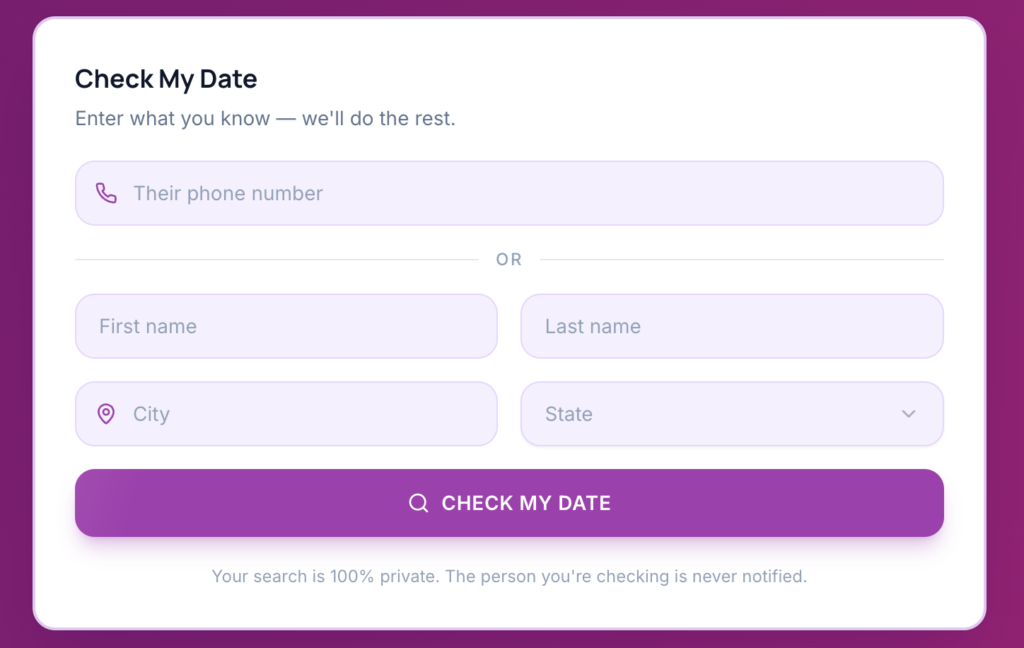
Stud or Dud launched in the US on 26 August, and the premise is exactly as blunt as the name suggests. You type in a name, a phone number, a city or a state. It goes off and pulls together whatever it can find in public records – court filings, bankruptcies and tax liens, property, employment history, address history, marriage and divorce records, social posts – and hands it back as a single report with an AI-written summary sitting on top telling you, in plain English, whether he’s worth booking the babysitter for.
It also awards red flags and green flags. There are literal buttons at the bottom marked Mark as Stud and Mark as Dud. Subtlety is not the point.
What Stud Or Dud Actually Does
Behind it is PeopleFinders, the Sacramento-based data broker that has spent years making public records searchable for anyone willing to pay. Stud or Dud is essentially that business model with date safety in mind – the same aggregated court, property and phone-directory data, repackaged for the group chat.

Each report splits into four categories: finances, property and assets, employment, and criminal records. Above them sits a “Safety Breakdown” rated Low, Moderate or High, plus a “Worth Knowing” list of the things the platform thinks you’d want raised over the first negroni. The sample report on the site – fictional, they’re careful to say – flags a dismissed 2017 DUI, a satisfied civil judgment from 2019 and a divorce with no children, then summarises all of it as: “Established Star City homeowner with a steady design career – minor flags from his early 20s are well behind him.”
“Daters today have access to more information than ever, except about the person sitting across from them,” said Amber Higgins, CEO of PeopleFinders, in the launch announcement. “Stud or Dud changes that dynamic by giving people additional context before they meet up, while leaving the ultimate judgment to the user.”
Pricing starts at $5 for a single credit – the “Vibe Checker” – and climbs to $8.97 a month for five saved profiles and 50 AI chats, or $19.97 a month for 25 profiles, deeper report categories and PDF exports. Searches are private. The person being looked up is never told.
The Numbers Say We’re All Doing This Anyway
If the whole thing sounds a bit much, the research suggests it’s only formalising something almost everyone already does. According to figures cited by Fast Company, 64% of daters research a match online before meeting them – 80% of women, against 49% of men. Around 15% have gone as far as an actual background check, and 39% say they’ve turned up something sketchy.
And the case for caution is not hypothetical. City of London Police reported in May that UK victims lost £102 million to romance fraud in 2025 across 10,784 reports – a 29% jump on the year before, with an average loss of £9,500 per victim. “Romance fraud is particularly harmful because it targets trust and emotional connection,” said Detective Superintendent Oliver Little.
So no, wanting to know who you’re meeting is not paranoia. It’s safety.
Now For The Important Part
Here’s where it gets sticky. Stud or Dud is not a background check, and the company says so itself, repeatedly, in its own FAQ. It is not a consumer report, not tenant or employment screening, and legally cannot be used for hiring, housing, credit or insurance decisions. Of the AI summaries, the site states plainly that the commentary “is not a factual finding, legal conclusion, safety assessment, compatibility determination, or character judgment.”
Which is a lot of hedging for a product whose entire interface is a verdict.
Public-records data is also famously messy – incomplete, out of date, duplicated, or attached to the wrong person entirely. The Electronic Privacy Information Center has long warned that people-search results can quietly cost someone a job or a flat. Here, a mismatched record just costs a stranger a date – until it doesn’t.
Then there’s the assumption baked into the whole thing: that the person doing the searching is the one at risk. A tool built to help a woman vet a stranger works exactly as well for an ex who wants a current address. The platform’s terms forbid using it to stalk, harass, dox or intimidate anyone – but terms are not a technical control.
And a clean report tells you very little. Sexual violence remains one of the most under-reported crimes there is; the overwhelming majority never reaches a police report, let alone a court record. “No red flags found” is not the same sentence as “safe”.
Anyone who watched the Tea app breach unfold last summer already knows the other risk. That app – built so women could warn each other about men – leaked around 72,000 images including selfies and ID photos, followed days later by more than a million private messages. Safety tools are also databases. Databases leak.
Can You Use It In The UK?
Not really, and that’s the short version. The search form offers a dropdown of US states and territories and nothing else, because the product only works in a country where court filings, property deeds and voter data are this openly available. Britain simply doesn’t publish its citizens the same way, and UK GDPR takes a dim view of building profiles of people who haven’t agreed to it.
Which leaves us where we started: the group chat, and the “Are We Dating The Same Guy?” Facebook groups that have been doing this work for free for years – and are currently generating a healthy stream of defamation and privacy claims for London law firms in the process.
So, Stud Or Dud?
The instinct behind it is completely reasonable, and the honest read is that Stud or Dud hasn’t invented anything – it’s something we’ve already been doing as amateur date detectives (at 11pm with three tabs open.)
What it has done is turn a background check into a product with a subscription tier, an AI verdict and a permanent record of who you looked up. If you’d rather not be in it, the company will process a deletion request without making you create an account first.
Just don’t mistake a green flag for a character reference. The report can tell you he owns his flat. It cannot tell you he texts back.
Some of the products and services featured in this article may be from our affiliate partners, which means we may earn a small commission if you make a purchase through these links — at no extra cost to you. Our editorial team only spotlights what we genuinely love and think you will, too.