
Picture the scene: 14 tabs open, three near-identical Gucci Marmonts, and absolutely no idea which one is the better buy. Vestiaire Collective has seen your browser history. And it has decided the fix is a chatbot.
The Paris-based resale platform has launched its own app inside ChatGPT, officially announced on 12 November, which lets you search its catalogue of nearly six million pre-loved pieces by simply describing what you want.
So What Does It Actually Do?
Two things, mainly.
It searches like a friend who works in fashion. You type what you are after in plain English – a brand, a vibe, a budget – and ChatGPT pulls matching listings straight from Vestiaire. The example prompts on the app’s ChatGPT listing give you the idea: “I want a Chanel bag for special occasions” now counts as a search term.

It compares. Pick two or three listings and the app lines them up side by side on details like price and condition, all in the same conversation. Which sounds small. It isn’t.
Why The Compare Button Is The Clever Part
Resale is not like normal shopping. On a regular retail site, a bag is a bag: same price, same condition, 400 in stock. On Vestiaire, every single item is a one-off. The same style might be listed dozens of times, each with a different price, a different level of wear and a different seller in a different country.
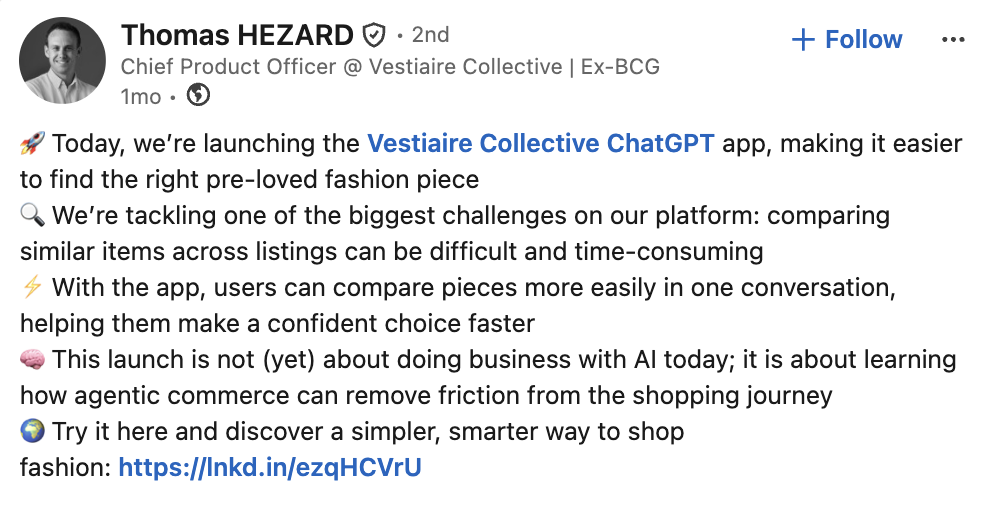
Thomas Hezard, Vestiaire Collective’s chief product officer, said as much when he shared the launch on LinkedIn. Comparing similar items across listings, he wrote, is one of the biggest challenges on the platform – difficult and time-consuming. The app is designed to squash that into one chat so shoppers can, “compare pieces more easily in one conversation, helping them make a confident choice faster.”
The demo he posted makes the point nicely. A search for a red Gucci GG Marmont returns more than 999 results. Two of them sit side by side: one at €746 (down from €829) shipping from Italy, the other at €540 from Czechia. Each has a Compare button underneath. That is a €200 question, and until now you answered it by squinting at two tabs.
Can You Buy It In The Chat?
No. ChatGPT does the finding and the choosing. When you spot something you love, you hit “View” and land on the Vestiaire listing itself, where you can make an offer or buy it as usual. Nothing is paid for inside ChatGPT.
Hezard was upfront about why. The launch, he wrote, is “not (yet) about doing business with AI today”. It is about learning how agentic commerce – the industry’s term for AI that shops on your behalf – can take the friction out of the journey.
When a commenter asked whether Vestiaire has an MCP, the bit of plumbing that would let other AI agents plug into its catalogue, Hezard replied that it doesn’t for now.
How To Try It
Vestiaire says the app is available to ChatGPT users worldwide. Here is the short version:
- Open ChatGPT and install the Vestiaire Collective app.
- Type @Vestiaire Collective in a chat, then describe what you want.
- Refine it (“under £500”, “black not tan”, “something similar but smaller”).
- Ask it to compare your favourites, then tap “View” to go to the listing.
The listing also shows two built-in skills: Vestiaire Fashion Search, for hunting down one specific piece, and Vestiaire Shopping Planner, which puts together coordinated shortlists. So yes, you can ask it to plan a whole pre-loved outfit.
The Small Print
A couple of things worth knowing before you connect it.
Your chats may travel. According to the app’s listing, once you connect Vestiaire, ChatGPT may share relevant chats and memories with the app to give your requests context. You can manage that, or disconnect entirely, in your ChatGPT settings.
It only knows what the listing says. The comparison is built from the information sellers have provided. A chatbot cannot feel the leather or spot a scuff the photos missed. Sorting and sifting six million listings is exactly the sort of tedious job AI is good at, but the final once-over is still yours. Zoom in on the photos. Read the condition notes. Then buy.
The Bigger Picture
For Vestiaire, this is one half of a wider plan. In the company’s announcement, Hezard said AI has a part to play at both ends of the business: making it simpler for sellers to list their pieces, and making it easier for buyers to find things in that enormous catalogue. The stated aim is to lower the barriers to circular fashion.
It also tells you where shopping is heading. The search bar is slowly turning into a conversation, and fashion tech companies are racing to make sure they are in the room when you ask the question. Vestiaire just pulled up a chair.
Some of the products and services featured in this article may be from our affiliate partners, which means we may earn a small commission if you make a purchase through these links — at no extra cost to you. Our editorial team only spotlights what we genuinely love and think you will, too.