
Let’s be honest about foundation. Somewhere in your bathroom cabinet is a shade that looked perfect under shop lights and then you realised the same bottle contained the what looked like an orange mask at IRL. Possibly two. Possibly a small graveyard of them.
Estée Lauder Companies has decided that foundation shade matching isn’t a shade range problem. It isn’t a shopping problem either. It’s a science problem – and the group has gone to a British university to sort it out.
On 14 August, it announced a research collaboration with the School of Design at the University of Leeds. Leading it is Dr Kaida Xiao, Professor of Colour and Imaging Science at the Leeds Institute of Textiles and Colour (LITAC).

Estée Lauder is working with the University of Leeds to set new benchmarks for shade accuracy.
The plan, in short, is to build new scientific benchmarks for how the industry judges complexion products using, “advanced psychophysical methods – ways of studying how people see and notice differences, rooted in visual perception science – to investigate how individuals perceive colour undertones and detect subtle differences in colour,” explained Estée Lauder in an official statement.
In short: studying how people actually perceive skin tone, rather than how a machine measures it.
“By combining advanced colour science with research into how consumers perceive their own skin, this partnership aims to strengthen the development of luxury and prestige complexion-enhancing products with more precise shade matching and improved formulas. The findings could help establish new scientific benchmarks for evaluating foundation, concealer and other complexion products to deliver more natural-looking results in everyday life,” Estée Lauder confirmed.
Foundation shade matching: the gap between measuring and seeing
The industry can already measure your skin tone with impressive precision. Spectrophotometers, in-store scanners, the AI shade finders baked into every beauty app going. All of them will happily produce a number for your face.
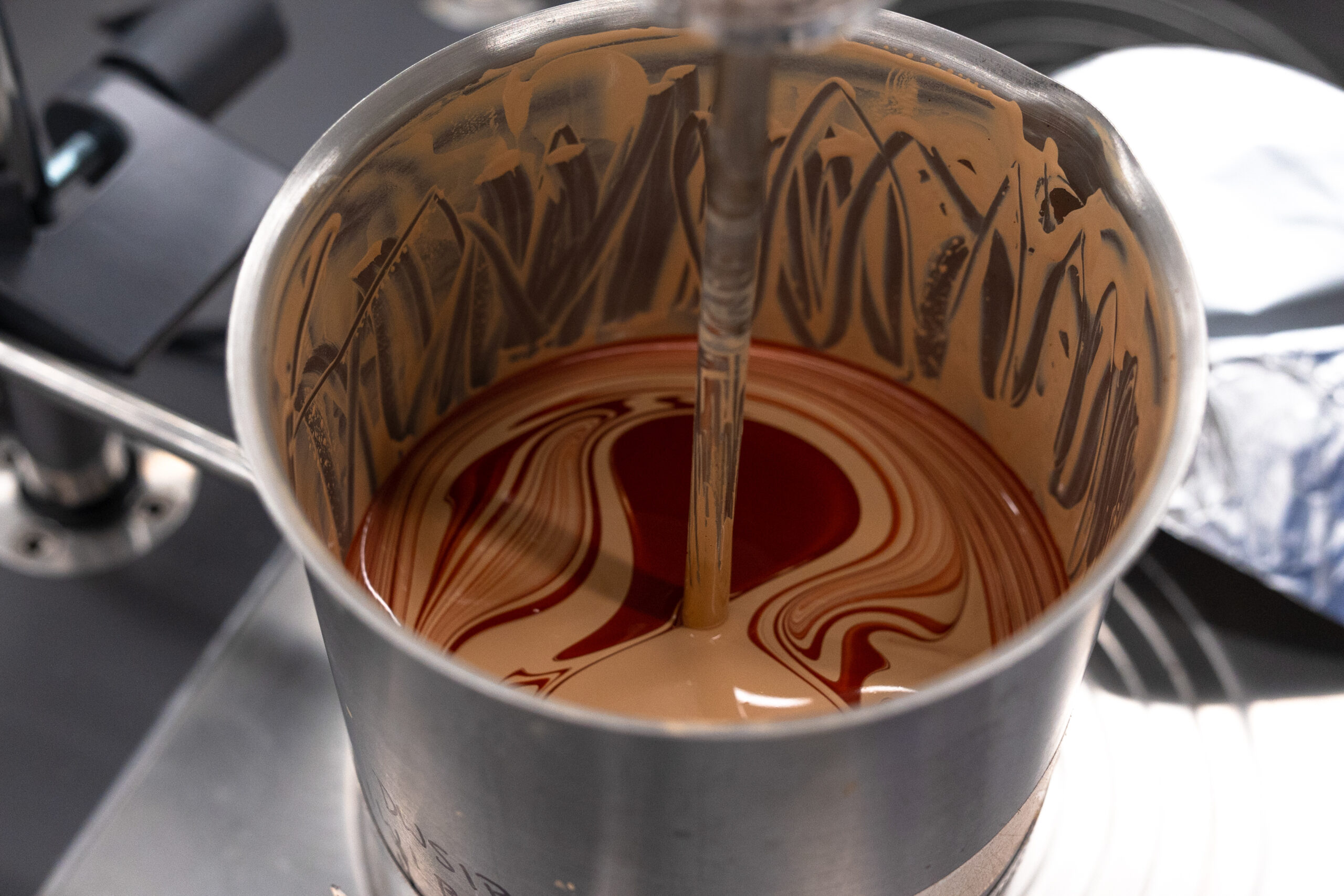
Getting a shade right starts with the colour science behind the formula.
However, none of them properly capture perception. How a shade reads under shop lighting versus your bathroom mirror at 7am. How your eye clocks an undertone. And the crucial one: at what exact point a subtle difference between two shades stops being invisible and starts being the reason you look faintly embalmed.
Claude Saliou, Senior Vice President, Advanced Technologies and Global Clinical and Consumer Sciences at The Estée Lauder Companies, explained,
“Delivering transformative innovation in complexion and colour cosmetics begins with a deeper understanding of how consumers perceive their own skin tone. While skin tone can be measured with increasing precision, understanding how consumers perceive their tone in the real world remains a complex scientific challenge. By partnering with the University of Leeds, a global leader in colour science, we have an opportunity to better understand how consumers experience shade matching in the real world. These insights help us improve shade accuracy, develop higher-performing formulas that look more natural and consistent, and support continued innovation across our luxury and prestige portfolio.”
Dr Xiao, who leads the work at Leeds, was refreshingly blunt about the difficulty,
“Skin colour perception is highly complex, shaped by subtle interactions between multiple factors. We are thrilled to collaborate with The Estée Lauder Companies, a global leader in prestige beauty recognised for its long-standing dedication to advancing skin science and its commitment to scientific excellence. This partnership brings together academic expertise and industry leadership to advance understanding in this important area of colour science.”
Psychophysics, and why it matters to your make-up bag
Psychophysics studies the relationship between a physical thing and the sensation it produces. Between a measurable wavelength and what a person actually reports seeing. Its bread and butter is thresholds: the smallest difference between two colours a human can reliably spot.
Applied to foundation shade matching, therefore, that means answering questions beauty has been winging on instinct for decades. How far can a foundation drift from your real tone before you clock it? Does that threshold shift across different skin tones and undertones? Does it change under warm light, daylight, a front-facing camera at brunch?
Nail those benchmarks and “matches your skin” stops being a marketing claim. Instead, it becomes something testable. Which is a bigger deal than it sounds.
Meanwhile, Leeds is a fitting home for it. The university’s colour science pedigree grew out of the city’s textile industry. Getting a dye to read identically batch after batch was a commercial necessity there long before anyone scanned a jawline with a phone.
Before we get carried away
Worth being clear about the limits of what this does for foundation shade matching. It’s a research partnership, not a launch. Neither side has disclosed the length or the financial terms. The group hasn’t said which brands go first. And there’s no timeline for when any of it reaches a counter or an app.

Above all, academic research at this scale runs for years. The output may well be a published methodology rather than a bottle you can buy. After all, this is not the industry’s first promise on the subject. Shade inclusivity became a competitive necessity after 2017. Ever since, the gap between the number of shades a brand offers and the number that genuinely work has drawn persistent, criticism. That’s especially true for deeper tones, and for undertones that refuse to sit neatly in the warm vs. cool bracket. A research partnership is a real step forward. But it is not a range on a shelf… yet.
Why we care about foundation shade matching
This is a vote of confidence in British research from one of the biggest beauty groups on the planet. The research that decides whether your next foundation looks like your actual skin-tone, is happening in Leeds.
Most beauty tech news is about adding another layer. An app, a scanner, an AR try-on, an AI recommendation. This is rarer, and perhaps more useful. Every virtual try-on is only as good as the colour science underneath it. And nobody built that science for this job in the first place, until now.
More on where beauty and technology meet in our guide to beauty tech in 2026, and our report on AI skin analysis moving beyond the face.
Some of the products and services featured in this article may be from our affiliate partners, which means we may earn a small commission if you make a purchase through these links — at no extra cost to you. Our editorial team only spotlights what we genuinely love and think you will, too.