
Somewhere on the first floor of Omotesando Hills, a mirror is quietly forming opinions. Not the ambient, self-inflicted kind you bring to any reflective surface after a red-eye – actual, data-backed, algorithmically considered opinions. About your face shape. Your proportions. Your feature balance. And then, rather politely, it hands the whole dossier to a human being holding a makeup brush.
The mirror in question lives at shu:ARTstage, Shu Uemura‘s newly designed global flagship in Tokyo, and it is – per the joint announcement from the L’Oréal-owned Japanese artist brand and its tech partner Loook.ai – “the first smart mirror built into real glass”.
That phrase is doing more work than it appears to. Conventional smart mirrors are, if we’re being honest, screens doing an impression of a mirror: a camera films you, a display plays you back, and something in your brain quietly registers the difference. This one is genuine reflective glass. “Unlike traditional Smart Mirrors, customers see their true reflection while AI-powered 3D facial analysis appears seamlessly on the mirror itself,” the announcement notes – the intelligence floats over your actual face, not a video feed of it.
The experience begins with a touch interface styled as a digital makeup brush, a detail we find almost unreasonably charming. Tap in, and the mirror walks you through a short sequence: a full face scan, a reveal of your face shape, a breakdown of your face ratio, an assessment of feature balance, and finally a personalised face ID summary.

@shuuemura
That summary is then translated into specific recommendations – brow shaping or contouring techniques suited to your particular architecture – along with a suggested next step: booking a sit-down session with a shu uemura makeup artist to bring it all to life. The whole exchange takes minutes, requires nothing downloaded, and produces the rare kind of retail data you might genuinely want to keep: a professional read on your own face.
Which is rather the point. This is not a machine that replaces the artist; it is a machine that briefs her. “We transformed shu uemura’s beauty mirrors into permanent AI-powered Smart Mirrors that analyse each person’s face shape and facial proportions in real time,” Loook.ai co-founder Nika Mantyka wrote on her Instagram, “It helps identify which features can be enhanced allowing makeup artists to make more personalised consultations and recommendations.” Nor was it an overnight install: “I’ve been working on this project for months, across multiple continents and we finally did it.”

@shuuemura
Loook.ai itself is no overnight arrival either. The company builds SaaS for smart mirrors and grew out of FFFACE.ME, the award-winning experiential studio, and has been shipping smart-mirror experiences since 2019 – hundreds of them, by its own count, built on AI, AR, big data and geo-marketing. Speaking to Personal Care Insights, Mantyka put the philosophy neatly: “A mirror has always been a passive surface,” she said – the ambition being to turn it into something closer to an advisor. In the company’s own pitch, the appeal for brands is friction removal – “no apps, no physical contact” – plus gesture-based interaction and real-time analytics that convert a lovely in-store moment into measurable dwell time and conversions. What you experience as a charming two-minute scan is, on the retailer’s dashboard, a performance channel. Both things are true. Welcome to modern retail.
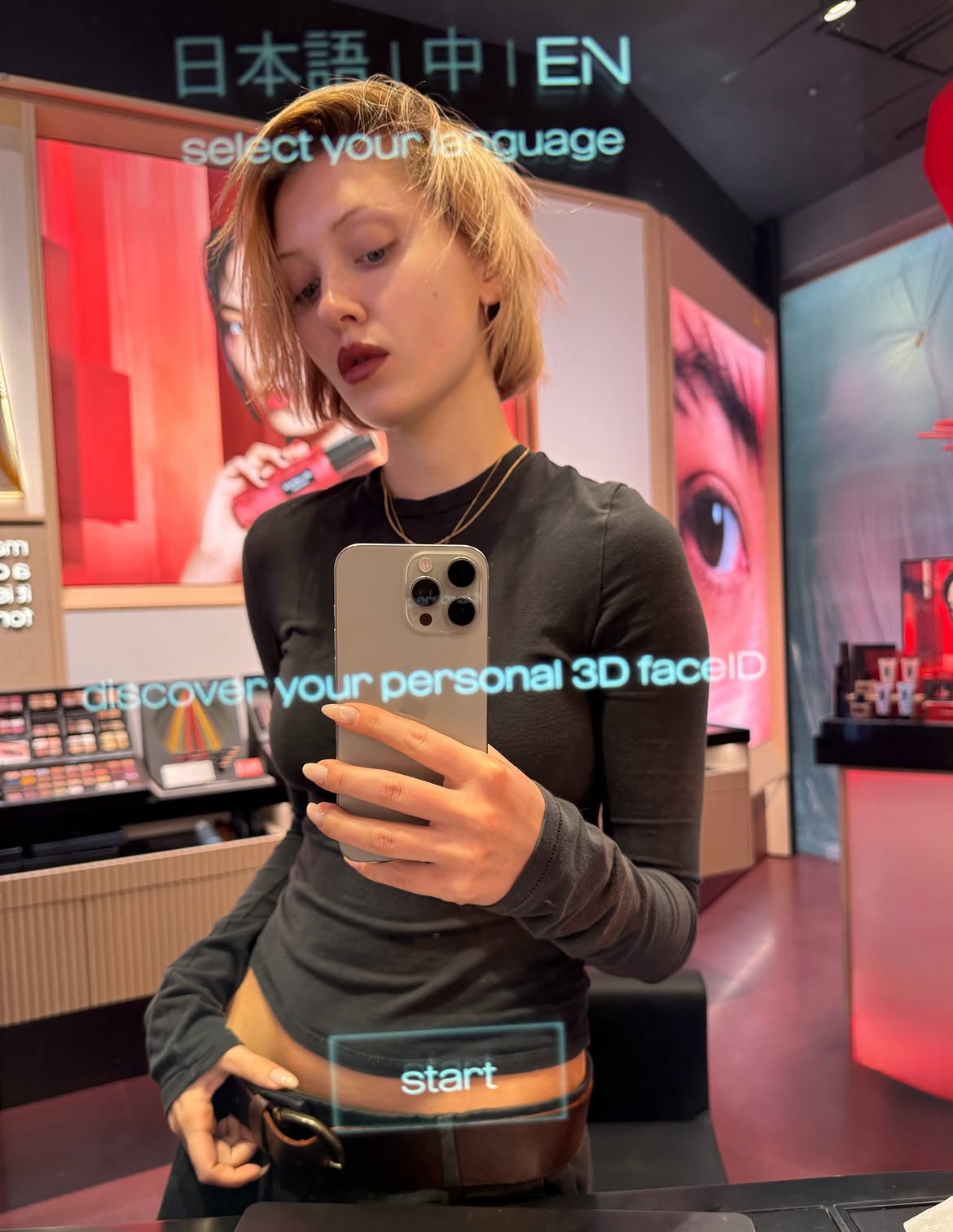
@nikamantyka
The setting matters, too. shu:ARTstage opened this June in Omotesando Hills’ West Building – on 19 June, no less, the birthday of founder and legendary makeup artist Shu Uemura, and the anniversary of the very first Beauty Boutique he opened in Omotesando in 1983.
“Tradition is a continuous cycle of innovation,” Jaron Chan, shu uemura’s International Brand General Manager, told Retail Technology Innovation Hub – which is precisely the sentence a heritage brand reaches for when installing an algorithm in the family silver. The AI Mirror is a permanent fixture, with multiple units integrated into a dedicated area of the store, and a digital layer is coming: customers will soon be able to scan a QR code to download a personalised card summarising their facial analysis, save it to their phone, or – obviously – share it on social media. The face card, we’d venture, is about to become the new birth chart. And do note the word permanent: this is not a pop-up to be quietly dismantled after fashion week, but infrastructure – a bet that the analysis, not just the lipstick, is now part of the draw.
View this post on Instagram
Now, the necessary pinch of salt. “Face ratio” and “feature balance” are phrases that live a suspiciously short walk from the internet’s least charming pastime: scoring faces against a golden ratio and finding them wanting. What separates a useful tool from a confidence-adjacent scorecard is what happens to the numbers – and here, credit where due, the numbers are routed not to a leaderboard but to a trained artist whose entire discipline is working with a face rather than grading it. Still, a scan is a scan: your face is now a dataset, and the usual questions – what is stored, where, and for how long – are worth asking of any beauty tech, this one included. Especially once it becomes shareable.
“This is more than a mirror. It’s the future of beauty, reflected,” the announcement declares. Grand, certainly. But the genuinely clever thing about this particular future is how little it announces itself: no headset, no app, no screen pretending to be something it isn’t. Just glass, doing what glass has always done – with rather more to say about your cheekbones.
Why we care: Beauty tech has spent a decade living inside our phones – filters, virtual try-ons, quizzes that end in a discount code. This moves the intelligence back to where beauty actually happens: into glass, in-store, beside a human with a brush. If AI’s most defensible job is making the personal more personal – rather than replacing the person – this is what that looks like. Expect every counter from Selfridges to Sephora to want one by spring.
Some of the products and services featured in this article may be from our affiliate partners, which means we may earn a small commission if you make a purchase through these links — at no extra cost to you. Our editorial team only spotlights what we genuinely love and think you will, too.
Leave a Comment