
Diamonds have always occupied that rare intersection between geology and mythology – a glittering shorthand for success, romance, and “I finally got a promotion big enough to justify treating myself.”
Whether tucked into an engagement ring or perched on a tennis bracelet, they have long carried a collective cultural weight: status, sentiment, and a whisper of “forever.” “Diamonds have traded on a sense of rarity… sustained more by perception than fact,” explains brand and marketing strategist Hilary Peltz.
With over a decade of experience scaling brands across luxury, fashion, wellness, hospitality and lifestyle industries Peltz, who is also the founder of luxury brand strategy agency in.Parallel, tells The Modems that this timelessness is built on an illusion.
It’s a perception that is cracking under the pressure of technology. Lab-grown diamonds – identical to natural stones in chemistry and appearance – can now be created in days, priced at a sliver of their mined counterparts.
In New York’s Diamond District, you can pick up a loose lab stone for US $135-$175 per carat. A natural equivalent? Ten to twenty times more. Suddenly, the most enduring symbol of luxury is facing the same disruptive reckoning we’ve seen across fashion, beauty, and even dating culture: what happens when technology democratises the previously unattainable?
RELATED:
The Rise of Conscious Jewellery Buys
Is This the Future of Gen Z Shopping?
The tension is simple yet existential: if anyone can afford a diamond, does the symbolism strengthen or dilute? And if the value collapses, what exactly are we paying for – the carbon, or the story? As Peltz notes, “Lab-grown diamonds have cemented themselves in the market,” reshaping not just price but prestige.
“A few years ago, lab-grown diamonds felt novel and buzzy. There was a lot of curiosity, and many clients wanted to explore the category simply because it was new. Over time, that conversation has matured,” renowned jeweller Stephanie Gottlieb, known for her custom creations and celebrity fans, told in.Parallel for their recent report; ‘A Diamond is Forever, Or Is It? Examining how the rise of lab-grown diamonds is reshaping perception, pricing, and prestige.’*

Credit: Stephanie Gottlieb
“Clients today are much more aware of the differences in long-term value, resale, and perception – and the declining price of lab grown diamonds. That awareness is pushing a lot of people back toward natural – especially for fine jewellery meant to last decades,” explains Gottlieb
But to understand the disruption that lab-grown has created, Peltz tells us that we first have to understand the fiction that built the empire…
The Original Diamond Dream:
The idea that diamonds were rare has always been a masterclass in branding – the pre-Instagram version of engineered scarcity. In 1888, Cecil Rhodes consolidated South Africa’s mines into what would become the titan De Beers. By the 20th century, De Beers controlled nearly 90% of the world’s rough diamonds, strategically restricting supply to maintain the illusion of scarcity. As Peltz notes, surplus stones were “locked in London vaults and released in tightly managed quotas.”
“Until the 1950s, diamonds had little to do with love. Signalling rank and status, they were worn in abundance on crowns and jewellery by royalty and the aristocracy. Instead, engagement rings worn by the wider public were often set with coloured gemstones, since few could justify the cost of diamonds. In fact, in 1939, only about 10% of American brides received a diamond ring,” explains Peltz.
“A Diamond Is Forever.”
Four words, written in 1947 by advertising agency N.W. Ayer, that turned geology into emotion, scarcity into desire, and a shiny carbon crystal into the ultimate proof of commitment. They built a love story so powerful it outlived monarchies, movie stars, and your brother’s questionable proposal in Santorini. Hollywood cemented the fantasy in Gentlemen Prefer Blondes and Diamonds Are Forever. By 1979, U.S. sales had skyrocketed from $23 million to more than $2 billion reported in.Parallel.
RELATED:
Why AI Is Changing How We Shop (and Date)
The Tech Behind Modern Luxury Branding
When Science Caught Up with Storytelling
In 1954, scientists at General Electric quietly pulled off what De Beers implied only nature could achieve: they manufactured a diamond. The first lab-grown stones were small and industrial, designed for tools, not jewellery. But the breakthrough foreshadowed everything happening today.
Fast-forward to the 2010s, when technological leaps in HPHT and CVD allowed labs to replicate natural formation with astonishing precision. The result? Diamonds “chemically and optically identical” to those mined from the earth – indistinguishable to the naked eye, and in many cases, even to seasoned gemologists. This time, technology didn’t just innovate the product; it disrupted the meaning attached to it.

The market dip no one saw coming: lab-grown diamonds dipping, everyday diamond use skyrocketing, and consumer habits changing. Source: in.Parallel
Markets responded accordingly. As in.Parallel reports, natural one-carat stones dropped nearly 27% between 2022 and 2024. Lab-grown diamonds now account for more than half of all engagement ring centre stones sold in the U.S.
Even De Beers – the architect of the diamond myth – wasn’t immune. Its lab-grown brand Lightbox shuttered as lab prices fell below US $800 per carat. Anglo American, its majority owner, wrote down billions in value and eventually announced plans to sell its stake entirely. When the inventor of the illusion retreats from its own story, you know the plot is shifting.
If Diamonds Are No Longer “Rare,” Where Does the Value Live Now?
In an era of hyperinflation, climate concerns, TikTok taste cycles, and the rise of a generation who enjoys subverting old luxury hierarchies, the idea of “value” has taken on new dimensions. Increasingly, the worth of a diamond isn’t in the stone – it’s in the brand, the craftsmanship, the provenance, the cultural capital.
Luxury jewellery houses have never been stronger. Richemont’s maisons grew 17% year-on-year; Tiffany posted 2% organic growth even as wider luxury cooled. Gold – a historically reliable asset – is soaring. The message is clear: consumers may be rethinking diamonds, but they’re not abandoning jewellery. They’re just recalibrating what feels worth paying for.
So What Do Gen Z & Millennials Prefer?
Antique diamonds have also emerged as a new status marker – one intertwined with craftsmanship, history, and scarcity that is real, not manufactured. Younger buyers, Gottlieb says, are “developing a deeper appreciation for antique stones and uniqueness. They’re gravitating toward pieces that feel one-of-a-kind and rooted in history, which naturally leads them back to mined diamonds.”
And when it comes to the emotional symbolism, Gottlieb is unequivocal, “Natural diamonds carry history, rarity, and value. When you work with natural diamonds, you’re holding something that has lived many lives – there’s a character you simply can’t replicate.”
RELATED:
Why Gen Z Loves “Data-Driven Beauty”
Inside the PFAS-Free Athleisure Revolution
Designers Are Recutting What Luxury Looks Like
In today’s jewellery landscape, diamonds are no longer reserved for milestone moments. They’re layered with T-shirts, stacked on wrists, worn to coffee runs and Pilates classes. This shift has opened the door to designers like Jessica McCormack, Arielle Ratner, Ming Jewellery, and Stephanie Gottlieb – women redefining modern luxury with bold, sculptural design and a distinctly millennial sensibility.
These designers lean toward natural diamonds – not because labs lack beauty, but because of the meaning their clients attach to the real thing. As Gottlieb explains, “There’s a very emotional component to natural diamonds. Clients talk about wanting something ‘real,’ something they can pass down, something that carries the symbolism of commitment or celebration in a way that feels lasting.”
For her clientele, a natural diamond still signals heritage and long-term value. And while lab-grown stones created buzz early on, Gottlieb has observed a shift, “Clients today are much more aware of the differences in long-term value, resale, and perception – and the declining price of lab grown diamonds. That awareness is pushing a lot of people back toward natural – especially for fine jewelry meant to last decades.”
Lab-Grown Isn’t a Threat – It’s a Different Category Entirely
For designers at the luxury tier, lab-grown diamonds haven’t cannibalised business, “Lab-grown hasn’t threatened our natural diamond business; if anything, it clarified our lane,” says Gottlieb, “Lab-grown diamonds have certainly expanded access and offered an option for people who are drawn to size and sparkle at a lower price point.”
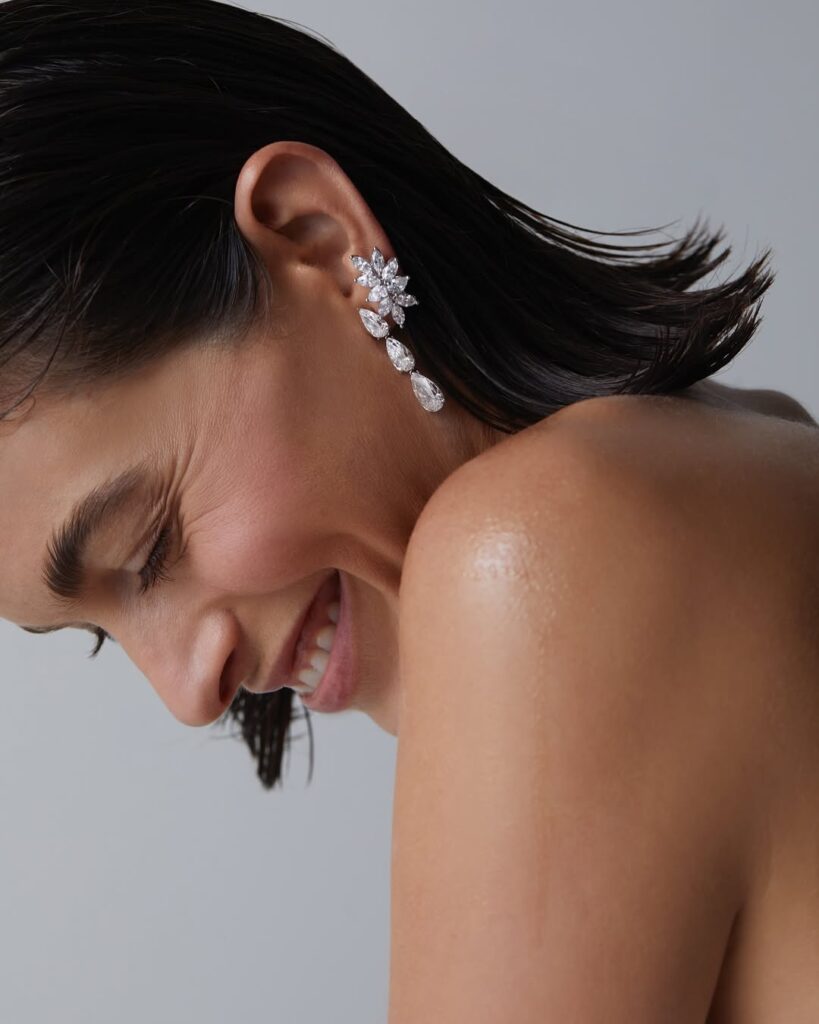
Credit: Stephanie Gottlieb
“But I think of them as a different category entirely. Natural diamonds sit in a luxury space; they have provenance and intrinsic value tied to the miracle of their formation.”
But for certain brands centred on accessibility such as – Brilliant Earth, Kimaí and VRAI – lab-grown is the point. It’s a category shaped by personal ethics, transparent pricing, sustainability messaging, and targeted towards millennial and Gen Z shoppers who appreciate the design flexibility that comes with lower cost.
A larger stone for the same budget?
A “starter” engagement ring that doesn’t require a house deposit?
A TikTok-friendly upgrade path?
It all tracks.
Lab-grown has not only democratised diamonds but accelerated this shift in consumer psychology: jewellery now behaves like fashion. Faster cycles, more experimentation, lighter financial commitment. And digital tools – from virtual try-ons to 3D custom builders – are making purchasing feel more approachable than ever.
RELATED:
The Future of AI-Powered Shopping
Inside the World of Next-Gen Wearables
The New Diamond Hierarchy: Meaning Over Myth
We’re entering a world where choosing a diamond is less about following a script and more about curating your own story – a world shaped by transparency, data, climate ethics, and the influence of tech-driven disruptors.
Here’s the new breakdown:
Lab-grown:
– Great for fashion jewellery
– Great for a bigger look for less
– Great for trend-led styling
– Symbolism? Optional
Natural diamonds:
– Still the emotional go-to
– Still the heirloom default
– Still tied to tradition and “forever”
– Still culturally sticky in a way tech can’t replace
Peltz explains that the old certainties are gone. Consumers must now weigh up “price, provenance, symbolism and status” – a decision matrix more akin to shopping for a luxury car than an engagement ring.
Gottlieb captures the emotional truth of this shift saying, “Looking ahead, I think the high-end and bridal categories will continue to strengthen around natural, while lab-grown will settle into a more defined role in fashion jewellery and trend-driven categories.”

The eponymous Stephanie Gottlieb proving (once again) that maximalist diamond stacking is not a trend – it’s a lifestyle.
Of course for jewellers such as Gottlieb, educating customers is par for the course, “What has shifted is education. We spend more time helping clients understand the differences – value, longevity, environmental claims, and the unique charm of natural stones. That transparency has built even more trust,” Gottlieb explains.
The Modems Verdict:
Technology has disrupted the diamond industry, but it hasn’t destroyed meaning. Instead, it’s forced us to interrogate what we value: the story, the science, the sparkle, or the symbolism.
In this new landscape, authenticity doesn’t mean “mined.” It means intentional. Strategic. Personal. Whether your diamond took millions of years to form beneath the earth or two weeks to grow inside a chamber, the real question is the one Peltz leaves us with, “What do you want the stone to say about you?” Because in 2025, a diamond is no longer forever. But meaning? That still is.
*These findings were originally published on in.Parallel, and have been republished on The Modems with permission of the author.
Some of the products and services featured in this article may be from our affiliate partners, which means we may earn a small commission if you make a purchase through these links — at no extra cost to you. Our editorial team only spotlights what we genuinely love and think you will, too.
Leave a Comment