
For decades, Japanese toilets have occupied a mythical place in global imagination.
Heated seats. Gentle bidets. Ambient soundtracks that spare you public embarrassment. The gold standard of bathroom luxury has long belonged to Japan – and no company more so than TOTO Ltd., the brand that turned washing your bum into a cultural export.
Now, TOTO is going a step further. Or rather – a step deeper.
This summer, the company is launching its most intimate piece of technology yet: a smart toilet that scans, analyses, and logs your stool, translating your most private daily ritual into actionable health data via a smartphone app. Welcome to the era where your toilet is no longer just about comfort – it’s about wellness, data, and preventive healthcare.
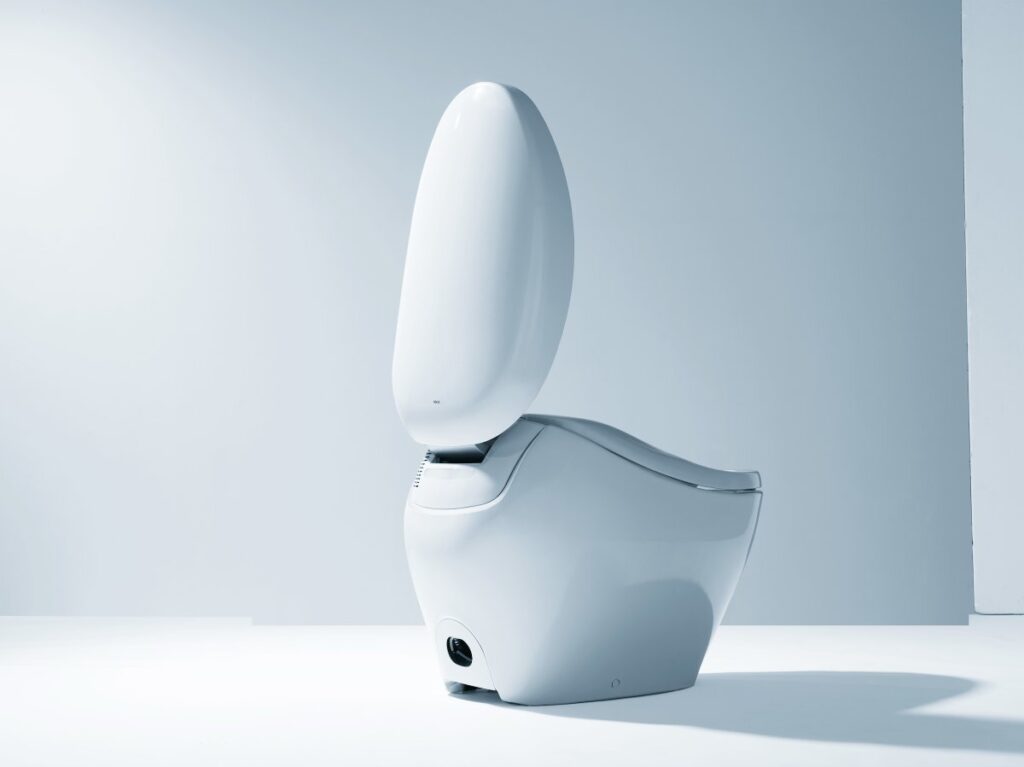
Under the hood of Japan’s most advanced bathroom tech. The Neorest uses discreet sensors to analyse patterns linked to gut health – no wearables, no apps in hand, just passive data collection built into everyday life.
Credit: TOTO
And yes, it’s exactly as futuristic as it sounds.
The Bathroom as a Health Dashboard
The new function, called “Stool Scan,” will be integrated into TOTO’s high-end Neorest toilet line from August 2025. Using a sensor installed next to the Washlet nozzle, the toilet scans stool as it falls into the bowl – classifying its shape, color, and volume and sending the data directly to the TOTO Wellness smartphone app.
Think of it as a wearable device, except instead of living on your wrist, it lives quietly in your bathroom – working passively, privately, and without asking you to lift a finger.
As TOTO explained on its official website; “Starting in August 2025, the Neorest toilet with integrated Washlet will be equipped with a new function, “Stool Scan.” This automatically measures the shape, color, and volume of stool during daily bowel movements, and the acquired data is recorded in the TOTO Wellness smartphone app, which displays lifestyle awareness information based on the condition of the stool.”
The ambition is clear: to turn the toilet into a daily health monitoring device, seamlessly embedded into an activity every human already does.
Why Stool, Why Now?
Gut health has quietly become one of wellness culture’s most talked-about topics – from microbiome-friendly diets to probiotic supplements and digestion-tracking apps. But while 76% of people check their stool after using the toilet, according to a TOTO survey, only 6% record that information digitally.
In other words: awareness exists, but consistency doesn’t. This is where automation comes in.
“It’s a product that links the toilet with an app. It has a new function called “Stool Scan” that can automatically measure the shape, color, and amount of stool, and that data can be acquired by the ‘TOTO Wellness’ app, which can then provide analysis results and information on lifestyle awareness,” explained TOTO’s Masashi Kawada, Group Leader at Washlet Development Department, “Wearable devices and body composition scales are well-known products that link measurement data with apps, but the most distinctive feature of the Neorest LS-W and AS-W is that they naturally support customers’ health habits through the everyday act of ‘defecating’ in the safe and private space of the toilet.”
In short: no manual input, no habit-building friction, no forgetting to log your data. The toilet does it for you.
How the Tech Actually Works
Unlike a camera (which raises obvious privacy concerns), the Stool Scan uses a line sensor, similar to those found in barcode readers and photocopiers.
According to TOTO, “It employs a “line sensor” similar to that used in barcode readers and copy machine scanners… making it ideal for capturing the shape and color of falling stool.”
The system categorises stool into seven types, based on the Bristol Stool Condition Scale – from hard clumps to liquid – alongside three colour categories and three volume levels. Behind this deceptively simple interface lies years of deeply unglamorous R&D.
Inside the Most Awkward Research Project Imaginable
Developing a stool-scanning sensor meant one thing: collecting stool data. A lot of it.
As Yuta Sakai, who led sensor development, admits, “At the beginning, there were no benchmarks for these, so it was necessary to simply capture and store a large amount of stool data.”
The team installed experimental devices at headquarters, labs, and even employee homes, with around 100 employees participating.
“We collected data on actual stool excretion, selected around 500 pieces of data that seemed usable from the roughly 1,000 pieces, and decided on the indicators.”
Some stool types proved harder to collect than others, “We just couldn’t get data for the two extreme types, Type 1 and Type 7… We finally managed to complete the data by taking supplements and controlling the condition of our own bowel movements.”
Now that’s serious commitment to the health tech mission.
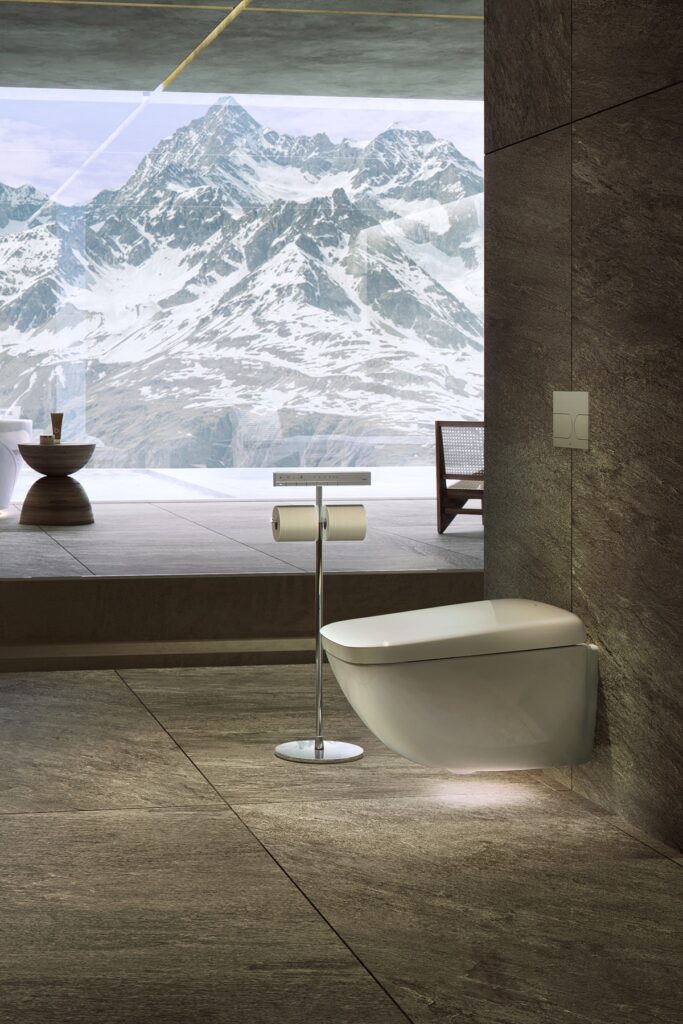
This isn’t just a bathroom – it’s a wellness retreat. TOTO’s smart toilets are designed to blend seamlessly into spa-like interiors, turning daily routines into moments of calm, data-driven self-care.
Credit: TOTO
Turning Data Into Behaviour Change
Raw data alone isn’t the goal. What sets the system apart is its recommendation engine, designed to gently nudge users toward healthier habits.
Kaori Nishijima, who led app development, explained, “The key point is that the stool scanning function automatically records information… I think there are many people who check the condition of their stool after a bowel movement before flushing, but few people record it every day.”
The app offers lifestyle suggestions like:
“Why not try making vegetable soup?”
“Make sure to get seven hours of sleep every night.”
Designing for Everyone (Not Just Biohackers)
Unlike wearables that skew young, male, or fitness-obsessed, toilets are universal. That presented a unique design challenge.
“Everyone uses the toilet, right?” Nishijima notes. “We avoided leaning too much to one side… and instead aimed for a UI that anyone could intuitively understand.”

Sleek, sculptural – and quietly intelligent. TOTO’s ‘Neorest’ prove that cutting-edge health technology doesn’t need to look like tech at all. This minimalist design hides advanced sensors that help users monitor gut health and wellbeing over time.
Credit: TOTO
The result is a system designed for continuity, not novelty – something that blends into daily life rather than demanding attention.
The Price of Progress
The Neorest models won’t come cheap. Prices start at 493,900 yen and go up to 542,300 yen – which is around £2,565 to £2,817 (or $3,300 to $3,650.) But TOTO is betting that consumers will see it as an investment: in preventive health, in longevity, and potentially in reduced medical costs over time.
As Kawada puts it, “We hope that our customers will be able to easily become aware of their stomach conditions and gain clues to change their behavior.”
The Bigger Picture: Toilets as Preventive Health Tech
This launch isn’t just about ‘poop’. It’s about a broader shift in how technology enters our lives – quietly, passively, and invisibly. “Providing a healthy and civilised way of life – this was the vision of our founder, and it has been continuously passed on to each of our employees,” TOTO states in its corporate philosophy.
In an era obsessed with self-tracking, optimisation, and wellness data, the most radical idea might be this: the future of health tech doesn’t just sit on your wrist – you could be sitting on it everyday… in your bathroom.
Some of the products and services featured in this article may be from our affiliate partners, which means we may earn a small commission if you make a purchase through these links — at no extra cost to you. Our editorial team only spotlights what we genuinely love and think you will, too.
7 responses to “Japan’s Latest TOTO Smart Toilet Turns Your ‘Waste’ Into Health Data”
-
… [Trackback]
[…] Info on that Topic: themodems.com/health/japan-toto-smart-toilet-scans-stool-and-tracks-health-via-app/ […]
-
… [Trackback]
[…] Read More here to that Topic: themodems.com/health/japan-toto-smart-toilet-scans-stool-and-tracks-health-via-app/ […]
-
… [Trackback]
[…] Read More on on that Topic: themodems.com/health/japan-toto-smart-toilet-scans-stool-and-tracks-health-via-app/ […]
-
Is there an updated model as of May 2026?
-
Instead of buying the entire toilet, do you sell just the gadgets?
Thanks,
Sonia -
… [Trackback]
[…] Info to that Topic: themodems.com/health/japan-toto-smart-toilet-scans-stool-and-tracks-health-via-app/ […]
-
… [Trackback]
[…] Read More here to that Topic: themodems.com/health/japan-toto-smart-toilet-scans-stool-and-tracks-health-via-app/ […]


Leave a Comment