
Founder of Code For Good Now, international keynote speaker and UN Women UK board member; Zehra Chatoo is one of the sharpest voices on responsible AI.
She built her career with what she describes as “a front row seat to AI during my time in Big Tech,” where she watched two things happen at once: the technology racing ahead, and women being left out of both building it and using it.
That front-row view became a mission. After senior leadership roles at Meta and Omnicom, she struck out on her own. “I believe we have a once-in-a-generation opportunity to shape this technology, but only if everyone has an equal opportunity to influence it,” she tells The Modems – the conviction behind Code For Good Now, her values-led consultancy helping brands grow responsibly in the age of AI.
Then came the experiment that made the industry sit up. Suspecting women’s slower AI adoption was less about skill than about judgment, Zehra ran two identical AI-assisted CVs and changed one detail – the name. “One was Emily Clarke. The other was James Clarke.” The result? “Emily was twice as likely to have her competence questioned for the exact same AI use.” She called it the AI Judgment Penalty, the first study to prove women are penalised for using AI in ways men aren’t – and Forbes, Fortune and the BBC came running, with Sheryl Sandberg and Reshma Saujani among those who shared it.
Crucially, it flipped the script: not a woman’s problem to solve, but a structural one for organisations to own. Today Zehra advises brands through her research, her Permission to Prompt training and REP IQ – all while lecturing at Oxford and turning up at Davos.
Her read on the moment we’re in? “This is an agentic moment” – and what thrills her isn’t the novelty, but what it frees up. From the AI she swears by to the beauty gadget she can’t live without, scroll on to find out which tech tools power her day…
The Download With Zehra Chatoo:
I had a front row seat to AI…
During my time in Big Tech and could see two things happening at once. AI was advancing at extraordinary speed, yet women were adopting it at lower rates and were significantly underrepresented in building it. That matters because AI is shaped by both the people who build it and the people who use it. I believe we have a once-in-a-generation opportunity to shape this technology, but only if everyone has an equal opportunity to influence it. That’s why I founded Code For Good Now, to help organisations build brands responsibly in the age of AI while closing the AI gender gap.
One of the first things I did…
Was put the idea in front of thirty of the UK’s leading CMOs, from Virgin Atlantic to Boots, at their annual retreat to test the business and mission. Having spent my career working with marketers at brands from Estée Lauder to Starbucks and Apple, I wanted honest feedback from the very people I hoped to help. Their questions and challenges shaped the business from the very beginning. It reinforced something I very much believe in: stay in pilot mode. Don’t wait until something feels perfect before getting feedback. Keep testing and be open to adapting.

Prioritisation was the hardest part…
There’s always more to do than time allows, and being ruthless about where your energy goes matters more than managing time itself. As a founder it’s impossible to do it all. Being ruthless in saying no was one of the most difficult things I’ve had to learn.
I self-funded the business…
Because I wanted the freedom to build around long-term impact rather than investor expectations. It meant taking more personal risk, but it also meant I could invest in research and building a business around a mission I genuinely believe in.
One of the things we offer to help close the AI gender gap…
Is an AI training programme called ‘Permission to Prompt’. But in order to design it effectively I needed to be incredibly clear on the why behind the AI gender gap. Previous research suggested it was driven by fear of judgment, but I wanted to know whether that fear reflected reality or just perception. So I ran an experiment using two identical AI-assisted CVs and changed just one thing: the name at the top. One was Emily Clarke. The other was James Clarke.
The results revealed a very real penalty. Emily was twice as likely to have her competence questioned for the exact same AI use. We called it the ‘AI Judgment Penalty’. Forbes, Fortune and the BBC picked it up, and Sheryl Sandberg and Reshma Saujani were among the leaders who shared it. It shifted the conversation from a skills gap, and a woman’s problem to solve, to a structural issue every organisation has to own. And it made clear what Code For Good Now stands for.
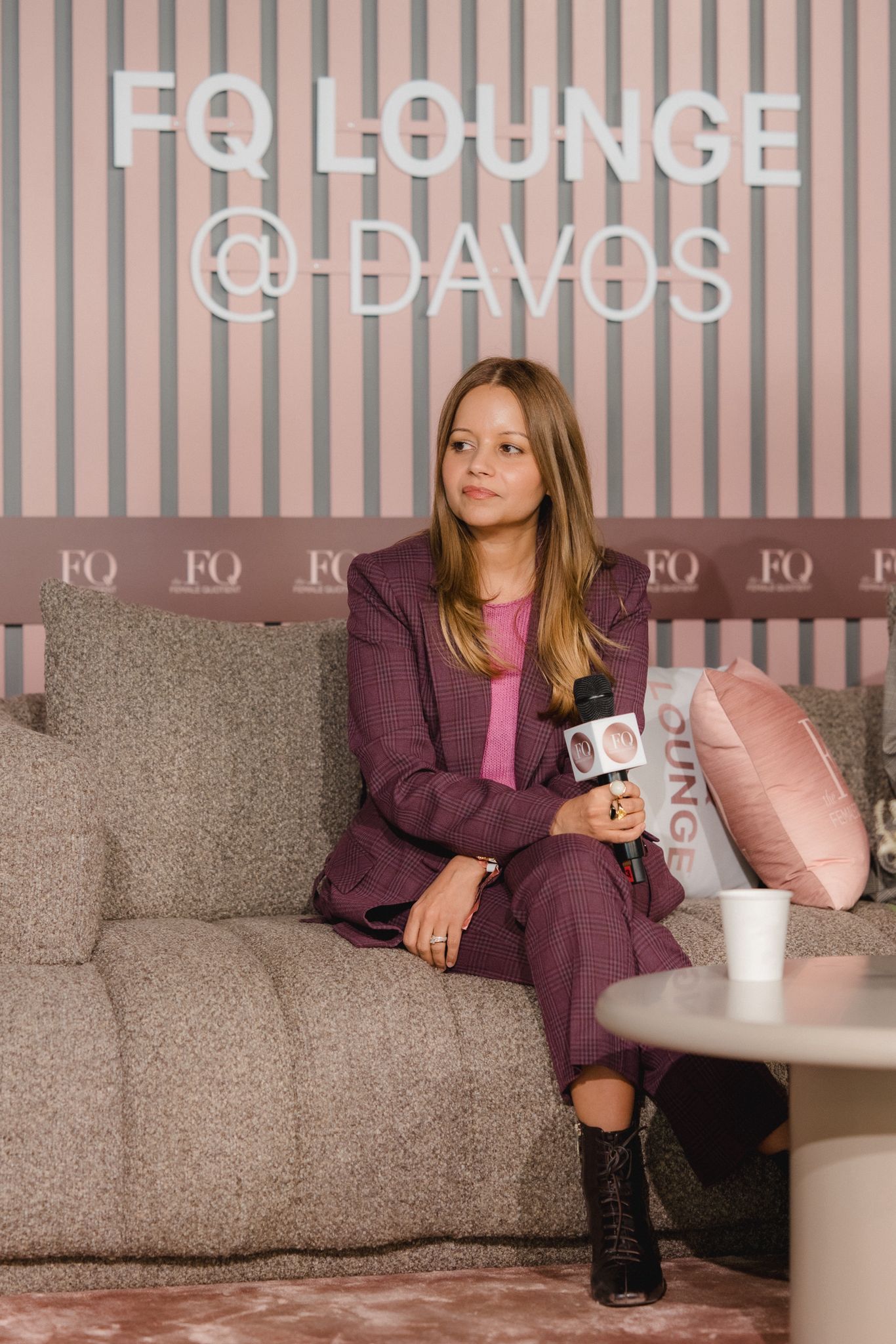
Zehra Chatoo at Davos
Moving from a large organisation…
You can’t expect the same certainty. At Meta, there was structure, resource and process behind almost every decision. As a founder, that certainty disappears overnight, and you’re building and learning every day instead. Not everything will go as you woul’d like, and that’s okay. When you don’t win, you learn.
I’m mission-based…
The time is now. AI adoption is being shaped as we speak, and the decisions organisations make over the next few years about how they build and adopt responsibly will be far harder to unwind later. That urgency keeps me going. Every organisation I work with has the chance to help shape a more equitable future for AI, and that always feels bigger than any single challenge.
Stay in pilot mode…
Don’t wait until something feels perfect before putting it into the world. Listen carefully, keep learning and be willing to adapt to what matters most to your audience.

The three gadgets I can’t live without…
My MacBook is where everything comes together – from research and keynote writing to client work. My iPhone is effectively my office in my pocket. And my productivity timer might be the least technical gadget on the list, but it’s one of the most valuable. It forces me to focus on one thing without distractions.
The platforms I use daily…
Claude, which acts like an extra co-worker and helps me move so much faster as a founder. Calendly, for scheduling without the back and forth. Calm, for meditation.
My top tech tip is…
AI Agents for me agents have really changed how I work, especially in the last couple of months, building things I would have never been able to build myself and removing a huge amount of the administrative burden.
How I stay updated with the latest tech trends…
I read a lot and block out time to do so, but I also learn a huge amount from spending time with founders who are building incredible things in AI. I also follow publications like The Modems and The Information to stay close to what’s happening across the industry
This is an agentic moment…
What excites me most isn’t the novelty of it, it’s what it frees up. When agents can absorb the administrative weight of running a business, founders get more time back for the parts of the work that actually need a human: judgment, relationships and strategy. That shift feels bigger than any single tool.
One tech trend I wish people would stop doing…
The idea that you have to be either completely pro-AI or completely against it. We can embrace the opportunities AI creates while still demanding accountability and remaining sceptical. I think being sceptical is one of the most important qualities we can bring to this technology.
The books that inspire me…
Thinking Fast and Slow by Daniel Kahneman
Feminist AI: Critical Perspectives on Algorithms, Data, and Intelligent Machines by Jude Browne
The podcasts I listen to…
On with Kara Swisher
How to Fail with Elizabeth Day
Aspire with Emma Grede
The fashion-tech I’m loving…
Alta – the Clueless moment is finally here.
The beauty-tech I swear by…
I can’t live without my LYMA
Modems Byte-Sized Questions:
 iOS or Android?
  Earbuds or Headphones?
  Text or voice notes?
  Dark mode or light mode?
  Filters or no filter?
  Apple Pay or designer wallet?
  Netflix marathon or TikTok scroll?
Neither – I love hard copy books and have lots of post-its and notes in them!
 Spotify playlists or YouTube deep dives?
  Most used emoji?
 Some of the products and services featured in this article may be from our affiliate partners, which means we may earn a small commission if you make a purchase through these links — at no extra cost to you. Our editorial team only spotlights what we genuinely love and think you will, too.
Leave a Comment