
Why we care: For twelve years, Bumble’s entire identity was a single mechanic: in straight matches, she speaks first or nobody does. As of yesterday, that rule is gone – anyone can now open the conversation. Bumble says women asked for it. Wall Street’s numbers suggest another story running underneath. Both can be true, and the collision is the most interesting thing to happen to dating apps in years.
Some products have features; Bumble had a doctrine. Founded by Whitney Wolfe Herd in 2014 on the principle that “when you make dating better for women, you make it better for everyone”, the app’s defining rule – women send the first message – was provocative enough to build a brand, a movement and, eventually, a public company. This week, that rule left the building.
What’s Actually Changing
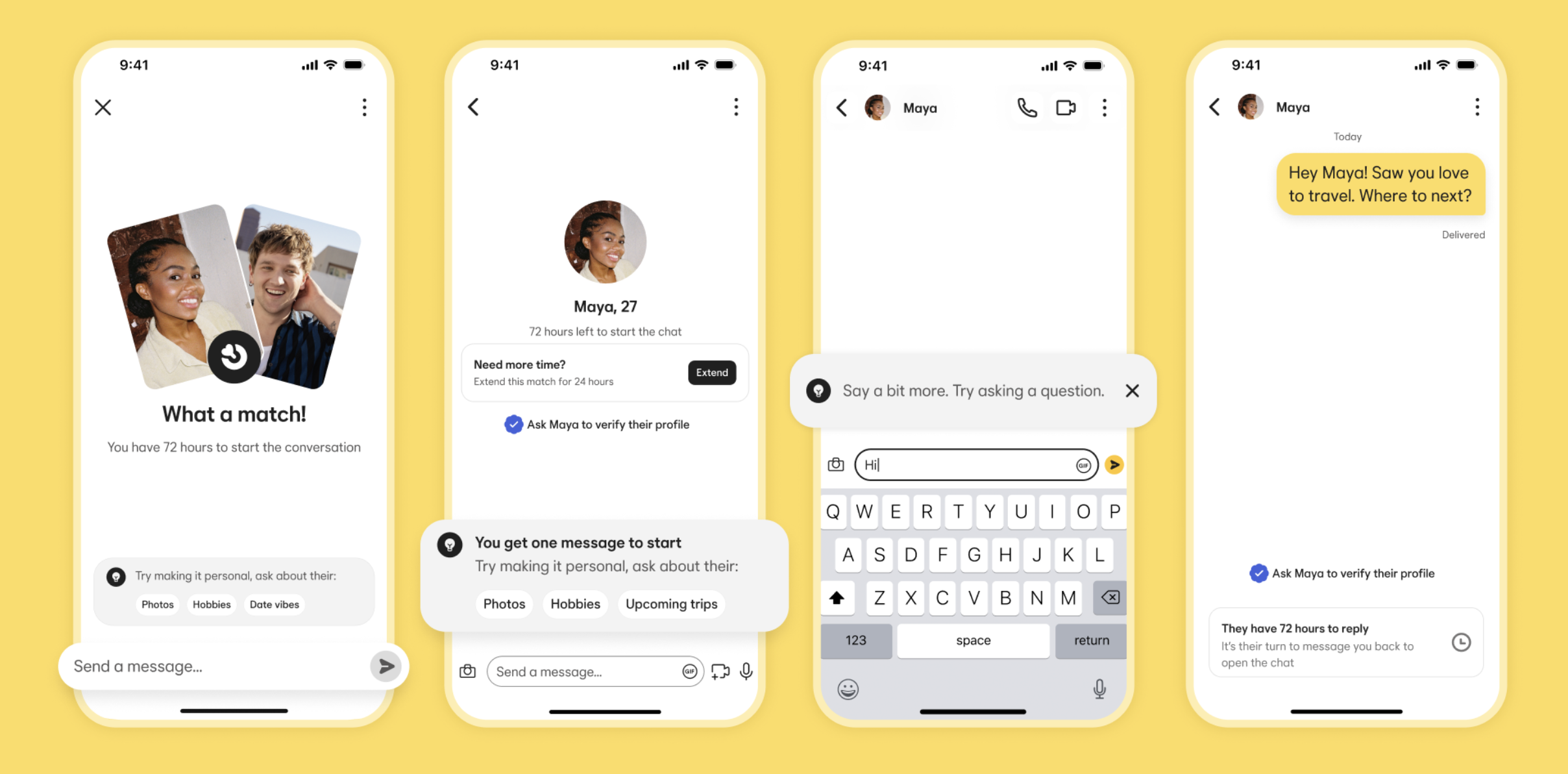
Under the “post-match evolution” rolling out globally from 11 August, anyone in a match can now send a single opening message. The chat only opens when the recipient replies – so an unanswered opener stays a closed door, not an open channel. Recipients get 72 hours to respond, tripled from the old 24-hour window. And in a detail we frankly wish every platform would adopt, low-effort openers get flagged before sending: per the press release, “If a member sends a low-effort message, such as one word openers, they will be prompted to be more thoughtful with their messages before they send.” The “hey” economy has been put on notice.
Wolfe Herd frames the change as continuity, not capitulation. “While women making the first move was a radical idea, being women-first was never about prescribing just one way to connect,” she said in the announcement. “Today, our community is asking for more flexibility, less pressure, and more opportunities to create real, meaningful connections and that is what this new experience provides. This evolution isn’t a departure from our founding vision, but the realisation of it.”
The Case Bumble Is Making
The company’s evidence file is genuinely interesting. Nearly two-thirds (66%) of women surveyed on Bumble say they prefer men to send the first message – with many, per the release, saying it “would make dating feel less pressured”. Among British Gen Z and millennials, 64% say they appreciate the flexibility for men to start the conversation, while 66% agree they feel more confident when they have choice over how and when conversations begin.
The product tests – run with members in Canada between June and July – reportedly showed higher chat initiation, opening messages “more evenly distributed between men and women”, fewer expired chats and less unmatching. Women in the test saw an increase in mutual chat rate more than twice that of men, and 92% of women said they still felt in control of their dating experience.
There is real lived experience behind those statistics. Any woman who has held a Bumble match hostage to her own procrastination knows the rule could feel less like empowerment and more like unpaid admin: the burden of crafting the opener, every time, on a deadline. “Less pressure” is not an empty phrase to anyone who watched a promising match expire at 23:59 because Tuesday happened.
The Case The Sceptics Are Making
As Reuters-style business coverage of the announcement noted, Bumble earlier this month forecast third-quarter revenue below Wall Street estimates and reported a 16.4% decline in paying users – part of an industry-wide malaise, with Match Group also reporting disappointing earnings throughout 2026 as users tire of swipe-based apps. Against that backdrop, a change that testing shows increases chat initiation and reduces expired matches reads, to cynics less like a feminist evolution and more like an engagement lever.
The commentary has been swift. “Bumble just deleted the one rule it was built on,” wrote Wall Street commentator and influencer Sammi Tannor Cohen. “And one of the mainstream apps quietly growing while the others shrink? The one whose entire motto is ‘designed to be deleted.’ The swipe apps that survive will be the ones brave enough to get you offline. Are we officially in the post-swipe era?”
View this post on Instagram
The Modems Take:
A few things worth holding at once. The research is largely Bumble’s own – internal data and commissioned surveys, per its own footnotes – which doesn’t make it wrong, but does make it the house’s numbers. The business pressure is real and disclosed. And yet the change itself is defensible on its merits: choice over compulsion is a reasonable definition of women-first design, the reply-only chat gate preserves women’s control over whether a conversation exists at all, and the thoughtfulness nudges attack the actual scourge of app dating (see: “hey”, “wyd”, the unsolicited “you seem fun”).
The deeper question is whether any messaging mechanic matters in an era when users are abandoning swipe apps for run clubs, supper clubs and anywhere with ambient lighting and no algorithm. Bumble says more experiences “focused on helping members move beyond the match and into real dates” are coming – which suggests the company knows exactly where this is heading.
The first-move rule made Bumble famous. Whether removing it makes Bumble’s audience (and profits) grow again is the question.
Some of the products and services featured in this article may be from our affiliate partners, which means we may earn a small commission if you make a purchase through these links — at no extra cost to you. Our editorial team only spotlights what we genuinely love and think you will, too.
One response to “Bumble Deleted Its Own Rule: The End Of Women-First Messaging, Explained”
-
I would like to chat to some women

Leave a Comment