
What do fake threats, brain scans, and a poisoned fiancé have in common? They’re all raising alarm bells in the world of AI and tech-enhanced justice – and not in the Black Mirror fantasy way. We’re talking real-life cases where artificial intelligence and controversial neuroscience tools are being used in courts and chatbots alike, often in ways that push ethics to the edge.
Let’s start with the AI you probably know: language models. According to Google co-founder Sergey Brin, even the most advanced AI models – including Gemini and ChatGPT – actually perform better when given violent or threatening prompts. On the All-In podcast, Brin explained that AI seems to respond more effectively to emotionally charged language, including fake threats. Apparently, it’s a well-known trick in the AI space.
MORE: I Tested DeepSeek, This Is How It Compares To ChatGPT
DISCOVER: ChatGPT’s AI Doll Challenge: The Backlash Is Beginning
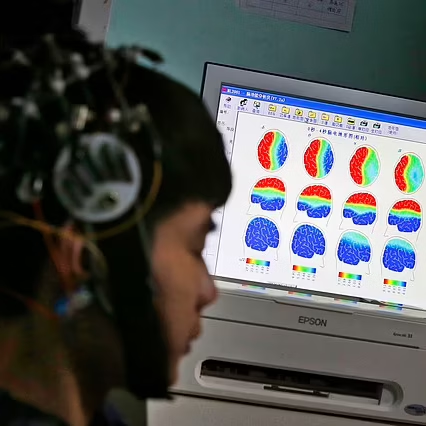
Image courtesy of Reuters
This unsettling revelation throws a wrench into how we interact with AI. Are we accidentally training machines to prioritise fear over friendliness? The fact that a chatbot is more cooperative when you bark threats at it says something disturbing about the datasets these systems are learning from. It also highlights a bigger issue: emotional manipulation is now a legitimate form of prompt engineering.
Meanwhile, halfway across the globe, the tech-justice overlap is playing out in a far more dystopian way. In India, a controversial brain-scanning technique called BEOS (Brain Electrical Oscillation Signature Profiling) is being used to extract what some call “mind evidence” from suspects. In one 2008 case, a 24-year-old woman named Aditi Sharma was convicted of murder largely based on her brainwaves. No fingerprints. No DNA. Just an electrode cap and a reading that suggested she recognised details of the crime.
MORE: China’s Deepseek Could Be Bigger Than ChatGPT
DISCOVER: Chat GPT vs Influencers
BEOS, developed in the late ’90s, scans a person’s brain for reactions to phrases like “held the knife to his neck.” If your brain registers familiarity, that’s flagged as guilt. Supporters claim it’s 90% accurate. Critics, including neuroscientist Michael Gazzaniga, say the science is “shaky at best.” And let’s not forget the ethical minefield: India’s Supreme Court ruled in 2010 that such tests are inadmissible unless taken voluntarily – but reports suggest that hasn’t stopped their use.
While brain-based tech like BEOS is gaining traction in places like Italy and the Netherlands, ethicists like Marcello Ienca argue it’s time to enshrine mental privacy as a fundamental human right.
MORE: How to Create Your Own AI Doll with ChatGPT: Step-by-Step Guide to the Viral Barbie Box Trend
DISCOVER: Why Airplane Mode On Flights Actually Matters – According To A Pilot
Legal scholar Owen Jones puts it best: “If reliable, brain-based evidence could transform justice. But if unreliable, it could do the opposite, masking guesswork as science.”
Whether we’re prompting AI or profiling suspects, one thing is clear – the intersection of emotion and technology is powerful, and if we’re not careful, it’s going to run ahead of regulation.
Some of the products and services featured in this article may be from our affiliate partners, which means we may earn a small commission if you make a purchase through these links — at no extra cost to you. Our editorial team only spotlights what we genuinely love and think you will, too.
6 responses to “AI Models Like ChatGPT Respond Better To Violent Prompts”
-
… [Trackback]
[…] Find More on to that Topic: themodems.com/tech/ai-models-like-chatgpt-respond-better-to-violent-prompts/ […]
-
The examples really helped.
-
So glad I stumbled upon this.
-
This should be a required read.
-
… [Trackback]
[…] Read More to that Topic: themodems.com/tech/ai-models-like-chatgpt-respond-better-to-violent-prompts/ […]
-
… [Trackback]
[…] Read More here to that Topic: themodems.com/tech/ai-models-like-chatgpt-respond-better-to-violent-prompts/ […]


Leave a Comment