
Space has always been sold to us as a place beyond earthly politics. A vacuum where gravity loosens its grip and humanity’s best instincts – curiosity, ingenuity, collective ambition – are meant to rise.
But when Amanda Nguyen boarded Jeff Bezos’ Blue Origin capsule in the spring of 2025, she learned the hard way that even 62 miles above Earth, the internet can still reach you.
Nguyen, 34, made history in April as the first Vietnamese woman to go to space aboard an 11-minute suborbital flight operated by Blue Origin. The all-female crew included Katy Perry, Gayle King, and Lauren Sánchez. The moment was framed as celebratory – a glossy, high-profile milestone for women in space. It was also instantly polarising.

Amanda Nguyen photographed in her flight suit – scientist, astronaut and activist – whose journey to space represents both a personal triumph and a broader conversation about how women in science are treated once they step into the public eye.
Credit: AP Photo
Critics questioned the environmental impact of private space tourism, the symbolism of celebrity-heavy crews, and the optics of billion-dollar rockets in an era of climate anxiety and global inequality. These are legitimate debates. But as Nguyen later revealed, the online response went far beyond policy critique. What followed, she said, was a “tsunami of harassment” that left her depressed, immobilised, and questioning how a lifelong dream had turned into something that felt like a punishment.
It’s a case study in what happens when innovation collides with algorithmic outrage, when public-facing science becomes content, and when women’s achievements are filtered through platforms designed to reward anger.
A scientist before the spotlight
Nguyen’s résumé doesn’t fit neatly into a headline. She is a bioastronautics research scientist whose work has focused on women’s health in space – an area historically underfunded and understudied. She is also a civil rights activist who became a national figure after surviving rape as a university student and discovering the statute of limitations had expired before she could seek justice.
Instead of retreating, Nguyen helped change the law. Her advocacy for sexual assault survivors led to her being nominated for the Nobel Peace Prize in 2019 and being named one of Time magazine’s Women of the Year in 2022. Space, for Nguyen, was not a vanity project. It was a deferred dream – paused while she fought for rights, then revived as a symbol of what persistence could look like.
That context mattered deeply to her. And yet, much of it was flattened by coverage that prioritised spectacle over substance.
When critique becomes cruelty
In a lengthy Instagram post shared on December 28 2025, Nguyen described the psychological toll of the backlash in unflinching detail. Speaking about a phone call with Gayle King shortly after the flight, she wrote:
“When Gayle called to check in on me in the aftermath of the spaceflight, I told her my depression might last for years. Another dream turned into a nightmare.”
She continued, “Everything I had worked for – as a scientist, my women’s health research, the years I had trained for this moment, the experiments I operated in space, the history that was being made as the first Vietnamese woman astronaut, on the 50th anniversary of the US-Vietnam war, as the child of boat refugees, the promise I kept to my survivor self – that dreams are worth fighting for, especially when we’ve deferred them to fight for rights – were buried under an avalanche of misogyny.”

A historic yet controversial moment in modern spaceflight: the all-female Blue Origin crew photographed ahead of their suborbital mission, a flight that reignited global debates around space tourism, representation, and the emotional cost of visibility for women in tech and science.
Credit: Blue Origin
Nguyen pointed to the scale of modern media itself, “The volume of coverage was unprecedented. With social media and a 24/7 news cycle, it surpassed coverage of even the most historic spaceflights. At that scale, even a small fraction of negativity becomes staggering. It amounted to billions of hostile impressions – an onslaught no human brain has evolved to endure.”
That line – billions of hostile impressions – lands differently in a tech-literate world. Algorithms don’t distinguish between critique and cruelty; they amplify whatever drives engagement. Controversy travels faster than context. And women, especially women of colour in elite spaces, often become the lightning rod.
Nguyen described the physical consequences of that exposure. “I felt like collateral damage, my moment of justice mutilated. I did not leave Texas for a week, unable to get out of bed. A month later, when a senior staff at Blue called me, I had to hang up on him because I could not speak through my tears.”
The impossible performance of strength:
There is a particular burden placed on women who represent “firsts.” They are expected to be grateful, resilient, inspirational – never visibly shaken. Nguyen acknowledged that pressure, especially in relation to the organisations and sponsors who made her research flight possible:
“Publicly, it was important to me to remain strong, especially for the sponsors of my seat who made my research and dream come true. And I continue to be deeply grateful and count all the ways in which the flight has transformed for good.”
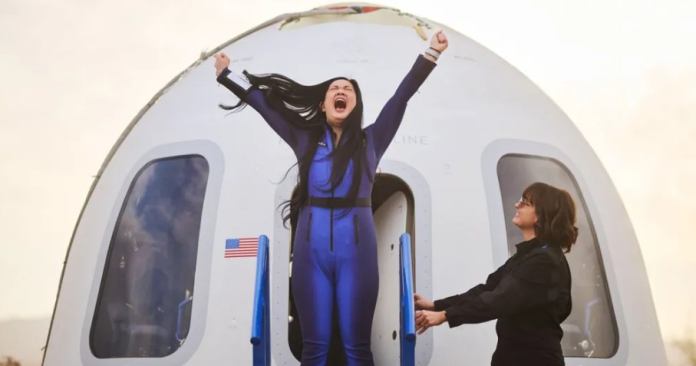
The moment of touchdown: Amanda Nguyen emerges from the Blue Origin capsule after becoming the first Vietnamese woman to go to space – an achievement later overshadowed by intense public scrutiny and online backlash.
Credit: Blue Origin
And there was good. Nguyen flew breast cancer research that benefited from global media attention. She gained access to world leaders, advancing her advocacy for survivors’ rights. For the 30th anniversary of reconciliation between the U.S. and Vietnam, lotus seeds she carried were exchanged as a symbol of peace.
As she put it, “My goal of science as a tool for diplomacy was achieved. There has been overwhelming good that has come out of this.”
Private spaceflight is no longer a distant sci-fi concept; it’s a content engine. Launches are livestreamed, dissected, meme-ified within minutes. The same infrastructure that allows young girls to watch a Vietnamese-American woman go to space in real time also enables pile-ons that can flatten a person’s mental health.
Nguyen was explicit about the mismatch between human psychology and digital scale, “At that scale, even a small fraction of negativity becomes staggering.”
For women who have grown up online – who have built careers, brands and communities through platforms that reward visibility – this feels uncomfortably familiar. Visibility is opportunity, until it isn’t.
Representation, reframed:
Eight months on, Nguyen says the fog has begun to lift. Travel to Vietnam, constant check-ins from friends, and support from her community played a crucial role.
“Vietnam saved me. My friends who continually checked in on me saved me.
The love of my community saved me. You all saved me.”
One of the most powerful moments in her post reframed the symbolism of her flight entirely:
“When Neil Armstrong stepped on the moon, bombs rained down on Vietnam. This year, when my boat refugee family looked at the sky, instead of bombs they saw the first Vietnamese woman in space. We came on boats, and now we’re on spaceships.”
Nguyen ended her reflection by returning to the idea of her “survivor self” – the younger version of her who learned how to endure public scrutiny in the fight for justice.
“In my moments of deep grief this year, I reached back out to a familiar place, to her – my survivor self – who found the strength to fight. How horrible that I needed to deploy that skill once again.”
There is exhaustion in that admission. Progress is often sold as linear; in reality, it can feel like reliving the same battles in higher-definition formats. Still, Nguyen found meaning in the response she received from strangers who took the time to understand her “why”:
“Every person who has shared with me what the power of representation means, every survivor that has shared with me a renewed sense of knowing that their dreams still can come true despite violence, every human who took the time to share my story above the noise.”
And finally, a message of cautious hope, “It’s been 8 months since then, and I’m glad that the fog of grief has started to lift… When the grief returns, I begin at your kindness. It is the greatest gift this holiday season that I can feel the fog lifting. I can tell Gayle it’s not going to take years.”
Amanda Nguyen’s story is not an argument for or against private spaceflight. It’s a reminder that technology is never neutral in how it’s received, circulated or weaponised. As innovation accelerates – and as more women step into hyper-visible, tech-adjacent roles – the systems around them need to evolve too.
Because reaching space should not require emotional re-entry burns. And progress, if it’s worth celebrating, should leave room for the humans who make it happen to land safely back on Earth.
Some of the products and services featured in this article may be from our affiliate partners, which means we may earn a small commission if you make a purchase through these links — at no extra cost to you. Our editorial team only spotlights what we genuinely love and think you will, too.
6 responses to “Amanda Nguyen Breaks Her Silence On “Tsunami Of Harassment” Post Blue Origin Spaceflight”
-
LOOOOOOOOOOOOOOOOOL
-
… [Trackback]
[…] Information to that Topic: themodems.com/tech/amanda-nguyen-breaks-silence-harassment-blue-origin-spaceflight-astronaut/ […]
-
… [Trackback]
[…] Read More here on that Topic: themodems.com/tech/amanda-nguyen-breaks-silence-harassment-blue-origin-spaceflight-astronaut/ […]
-
… [Trackback]
[…] Here you will find 12352 additional Information to that Topic: themodems.com/tech/amanda-nguyen-breaks-silence-harassment-blue-origin-spaceflight-astronaut/ […]
-
… [Trackback]
[…] Here you will find 25942 more Info to that Topic: themodems.com/tech/amanda-nguyen-breaks-silence-harassment-blue-origin-spaceflight-astronaut/ […]
-
… [Trackback]
[…] Info to that Topic: themodems.com/tech/amanda-nguyen-breaks-silence-harassment-blue-origin-spaceflight-astronaut/ […]

Leave a Comment