
A grassroots campaign alleges the platform’s AI moderation is banning legitimate sellers at scale, freezing their money and hiding the appeals process behind more AI. It’s become one of the fastest-growing UK consumer campaigns of the year, powered by a TikTok channel posting daily – and it’s a preview of a much bigger question: what happens when the algorithm gets you wrong and no human will pick up?
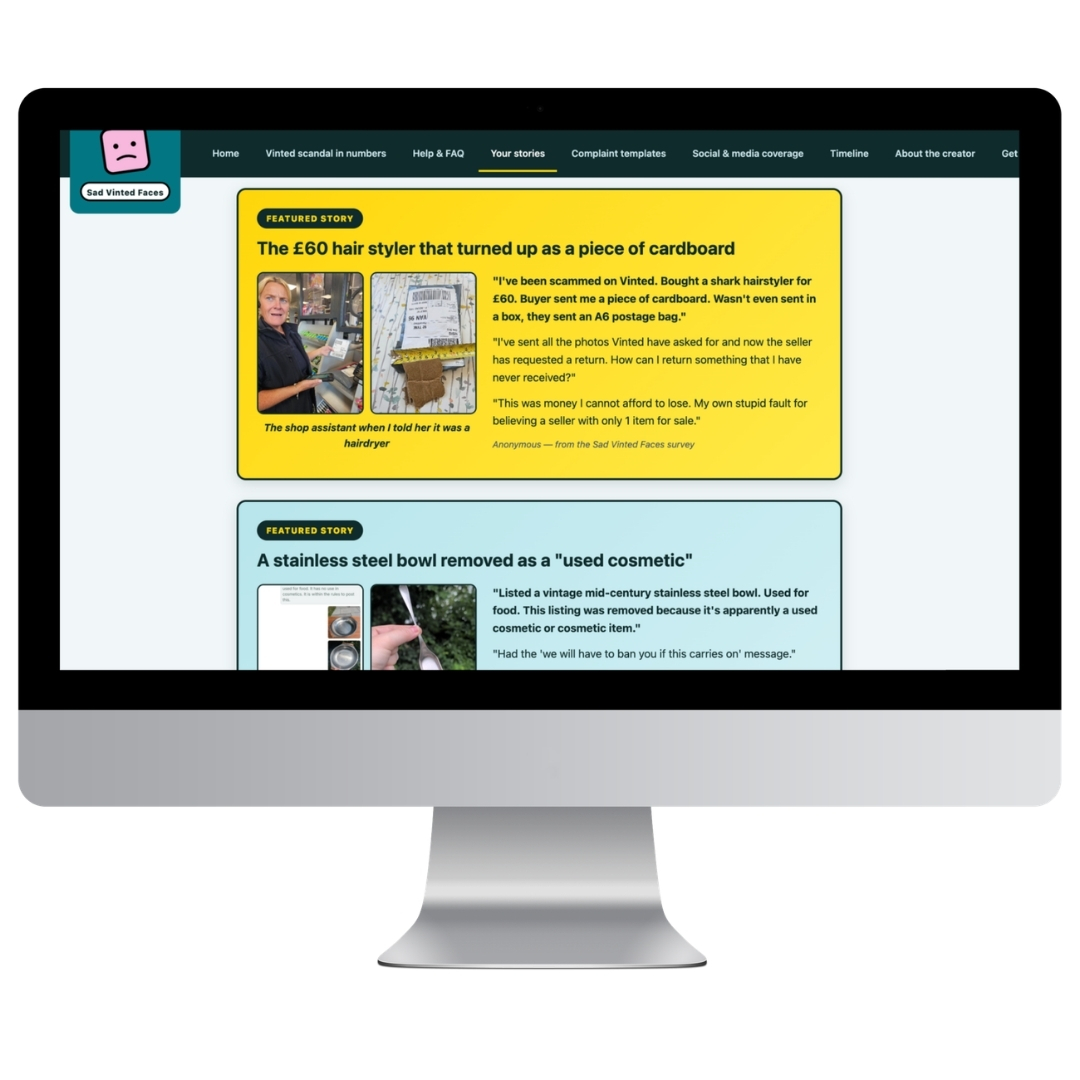
Every great consumer uprising needs an origin story, and this one begins with a Google Form. On 10 June, Catherine Warrilow – a Vinted buyer and seller with, by her account, 900 five-star reviews – launched a survey after her own account was repeatedly restricted with no clear explanation. Her Vinted career until then had been unremarkable in the best way: “I was happily selling things here and there that I no longer wanted, and buying the odd thing I liked,” she writes on the site the survey became, sadvintedfaces.com. Then she was scammed with a counterfeit item, lost money on a parcel that allegedly arrived as an empty envelope, and started hearing of “hundreds of cases far worse than mine”.
The first survey response arrived at 11:58am on launch day. Within 48 hours there were 250. A thousand within two weeks. By 17 July, over 2,500 – and the site’s live counter has since passed 3,700 reviews, with an average platform rating of 1.42 out of 5. Within three weeks, the campaign says, it had gathered enough evidence to prompt two Sunday Times investigations by Jessie Hewitson – the first headlined “‘I want the old Vinted back’: the second-hand selling backlash”, the second, “‘Vinted chaos has cost me £80k. What is going on?'” – followed by a BBC interview and interest from The Sun. One supporter’s verdict, per the campaign site: “You’re the Erin Brockovich of Vinted”. Her reply to the community is the closest thing the campaign has to a mission statement: “I won’t stop until Vinted fixes this mess. That’s my promise to you.”
What The Campaign Alleges
The thesis, in the campaign’s own words is that, “Vinted has replaced human moderation and customer service with an AI stack that is making catastrophic, high-volume false-positive decisions, then locked the appeals process behind more AI”.
The self-reported data is bruising. Of 1,909 respondents in the campaign’s published analysis, 59.4% say they’ve been banned at some point and 32.6% banned permanently; 40.4% report losing money, and 64.4% say they were ignored by customer service entirely, while 76.3% report receiving an irrelevant response. Of 417 who report being scammed, just 19 – 4.6% – say Vinted helped resolve it, a figure the campaign calls “the single most damning number in the dataset”. Self-quantified losses total roughly £95,000–£109,000 across the sample, with at least 303 respondents reporting losses of £50 or more, and free-text responses referencing far larger sums from banned Pro accounts. Notably, the majority of respondents are ordinary buyers-and-sellers rather than resellers – undercutting, the campaign argues, any suggestion this is merely commercial sellers grumbling.
The alleged failure patterns range from devastating to darkly comedic. There’s what the campaign calls the “Pro Account Trap”: sellers flagged for “commercial selling” and told they must convert to a Pro account, who duly complete HMRC registration – then get banned for commercial selling on the account that exists for commercial selling. Dozens of respondents describe this exact loop, some reinstated with an admission of error only to be banned again within hours.
@catherinewarrilow More progress! keep adding your stories to sadvintedfaces.com #vintedscam #vintedproseller #vintedtips #vinted #vintedban ♬ original sound – Catherine Warrilow
Then there’s the counterfeit bot, allegedly flagging Primark, Matalan, M&S and Tesco F&F basics as fakes – plus genuine Gucci and Canada Goose with receipts, and, in one case, a Monet costume necklace apparently confused with Monet the painter. Users report cocktail spoons flagged as weapons, a stainless steel bowl removed as a “used cosmetic”, Dolce Gusto pods flagged as prohibited beverages, and bans triggered by editing a listing at all: “I decided to update the description to say XS because somebody had asked me what size the mouse was. I was instantly banned,” one respondent told the survey. Another reports a permanent ban for using the word “type”, as in “Chanel-type bag”. One seller was reportedly told her photos looked “too professional”. One appeal denial, the campaign says, was signed off with paw print emojis.
Behind the stories are serious losses. One seller, who built a resale business with her late father’s inheritance – two 20ft storage lockups, stock, five to ten orders every couple of days – told the campaign: “I feel broken. Left with no income. Two 20ft lockups costing £3,200 a year to keep the business going.” Another, a single parent selling her family’s outgrown clothes, says she was “permanently banned for reducing the price of one of my items”, adding: “all I’ve been replied back with is automated messages from AI Bots.” The campaign also documents what it calls asymmetric Buyer Protection – buyers refunded while keeping items, sellers left to absorb the loss – and a courier “black hole” of missing InPost, Evri and Yodel parcels with 35-day investigation windows that expire unresolved.
The TikTok Engine
If the survey is the campaign’s evidence base, TikTok is its distribution network – and arguably the reason a Google Form became a national story. Warrilow’s Sad Vinted Faces account posts daily updates, and the numbers chart a creator finding her format in real time: the series hit 20 published videos by 7 July, then 30 by 17 July – ten new videos in ten days, the fastest content phase of the campaign. Per the campaign’s own timeline, TikTok has become “the campaign’s largest driver of new survey responses, feeding case studies directly into the corpus” – a genuinely elegant flywheel in which each video surfaces new horror stories, which become new data points, which become new videos.
The content itself is part consumer journalism, part practical toolkit. Alongside the case studies, the account walks banned users through appeal templates with legal wording – how to file a Subject Access Request under Article 15, how to challenge automated decisions and escalate to the Information Commissioner’s Office – and has even launched a “fix finder” tool for matching your specific Vinted disaster to the right complaint route. It’s also where the campaign’s cliffhangers play out: when Vinted Marketplace CEO Adam Jay replied to Warrilow’s LinkedIn message, the exchange became a multi-part TikTok series, complete with a “stay tuned for part 3”. For a community that had spent months shouting at chatbots, the emotional pull is obvious. As one supporter put it: “Seeing your TikToks gives us hope of not being alone in this”.
The Legal Turn
In July, the campaign escalated from stories to statutes. On 20 July, every case in its corpus was mapped against the specific UK laws it engages – from UK GDPR and the Consumer Rights Act 2015 to the DMCC 2024 – with ready-to-file complaint templates published on the site. On 21 July, Warrilow filed a formal complaint with the Lithuanian State Data Protection Inspectorate (VDAI), Vinted’s lead regulator, alleging systemic UK GDPR breaches affecting 2,554 UK users – and pointedly referencing the €2.39 million fine the VDAI itself issued Vinted in July 2024. A rapid series of formal requests for comment followed: on automated bans without meaningful human review (UK GDPR Article 22), on potential DMCC 2024 breaches, on counterfeit-related bans of genuine goods (Trade Marks Act 1994), and on alleged unfair trading practices. On 4 July, the concerns had already been set out in a direct email to Vinted’s institutional investors.
Our Impartial Take:
Some necessary framing. The survey is self-selected – unhappy users are far more likely to fill it in than the millions transacting happily, so the percentages describe the aggrieved sample, not Vinted’s whole user base. The losses are self-reported, the legal complaints are allegations awaiting regulatory assessment, and Vinted disputes at least some characterisations (the campaign notes the company insists its support responses come from humans). The company’s only leadership acknowledgement to date, per the campaign timeline, is Jay’s LinkedIn reply saying he is listening but would not be engaging further.
And yet: 86 accounts restored since the campaign began, per its live counter, suggests at least some bans didn’t survive scrutiny. Whatever the final regulatory verdict, thousands of documented cases of unexplained automated decisions – none of which, users report, ever cite the specific rule allegedly broken – is a customer-experience problem by any measure.
The bigger story is the one every platform should be reading. AI moderation at scale is cheap until it isn’t – until the false positives have names, lost livelihoods, and a very organised woman with a Google Form, a complaint template library and a daily TikTok habit. The algorithm may not explain itself. The internet, it turns out, will.
Some of the products and services featured in this article may be from our affiliate partners, which means we may earn a small commission if you make a purchase through these links — at no extra cost to you. Our editorial team only spotlights what we genuinely love and think you will, too.
Leave a Comment