
If you spot a suspiciously sensor-laden car gliding through Wembley in the coming months, no, you haven’t wandered onto a film set.
Freenow by Lyft – the ride-hailing app long beloved of London’s black-cab loyalists – has officially started testing autonomous vehicles on the capital’s streets, in partnership with Baidu’s Apollo Go, one of the biggest names in driverless technology on the planet.
“Our autonomous vehicles are out on London’s streets right now, learning every turn and traffic pattern,” Freenow announces on its new autonomous rides hub – and it means that literally. Throughout 2026, the fleet will be mapping and learning the city, starting in Brent and Wembley, before, in the company’s words, “expanding when we’re ready to grow our service”. Public rides are pencilled in for 2027, pending regulatory approval.
The Deal Behind The Wheel (Or Lack Thereof)
The London trial is the visible tip of a much larger arrangement. In August 2025, Lyft and Baidu announced a strategic partnership to deploy Apollo Go’s autonomous vehicles across Europe via the Lyft platform, with initial deployments planned for Germany and the UK in 2026 and “the fleet scaling to thousands of vehicles across Europe in the following years”, per the companies’ joint announcement.
“Our partnership with Lyft to deploy Apollo Go in Europe, starting with Germany and the United Kingdom, is a significant milestone in our global journey,” said Robin Li, Baidu’s co-founder, chairman and CEO, in that announcement, promising “safer, greener, and more efficient mobility solutions”.
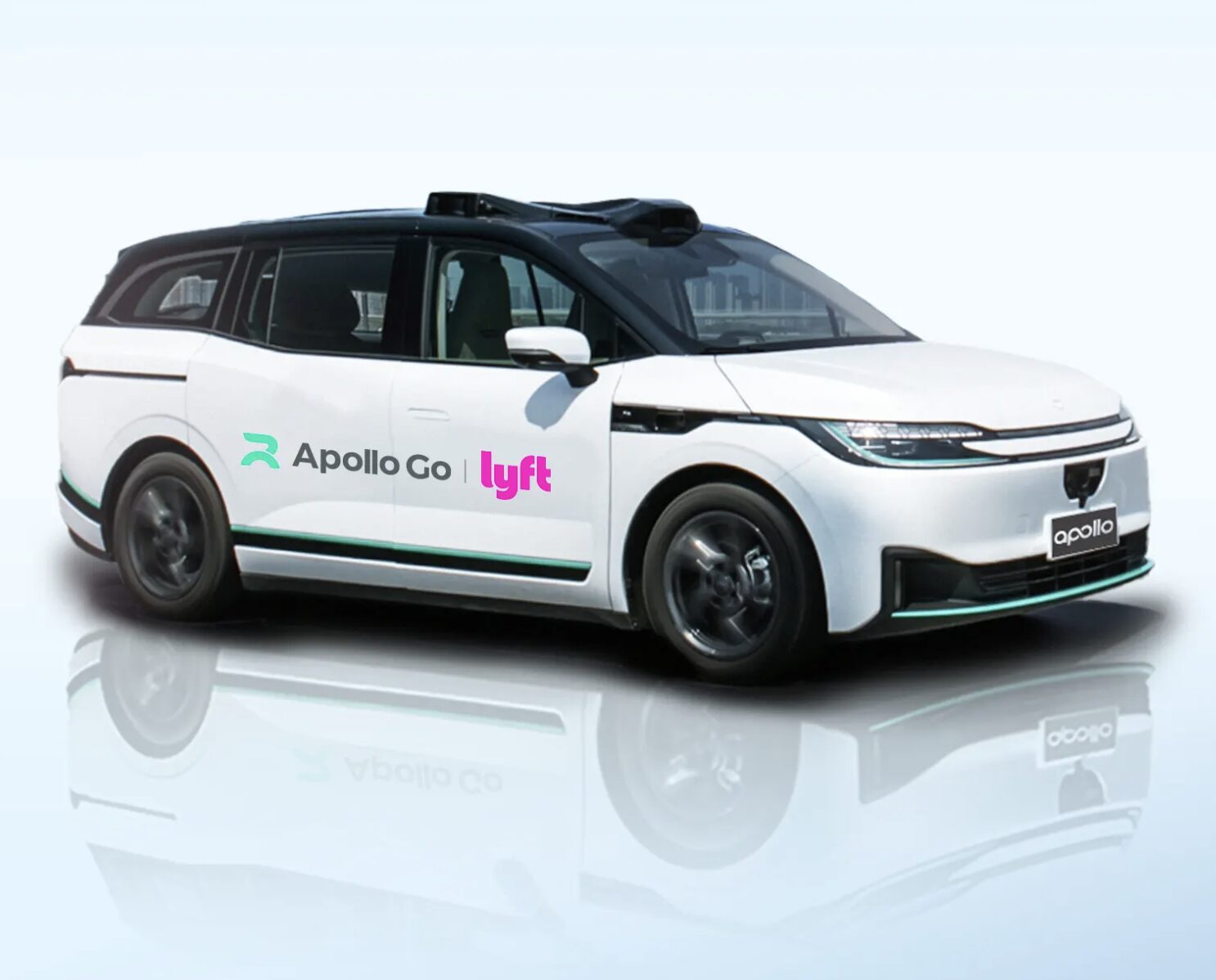
Lyft CEO David Risher framed it as a rider-experience play: “Their extensive track record operating the world’s largest autonomous ride-hailing service means we can bring all the benefits of AVs – safety, reliability, and privacy – to millions of Europeans.” Crucially, he added, “It’s part of our hybrid network approach, where AVs and human drivers work together” – which is corporate-speak for: the robots are joining the app, not replacing your favourite driver. Freenow echoes the point, describing “a hybrid network where you can choose between the expertise of a driver and the precision of autonomous driving technology”.
The cars themselves are Apollo Go’s sixth-generation RT6s – purpose-built, fully electric vehicles designed from scratch for ride-hailing, equipped with what the partnership describes as an industry-leading sensor suite and a “10-layer safety redundancy architecture”. Freenow puts it more romantically: cameras, radar and LiDAR building a real-time picture of the road, like “an attentive, experienced driver that can’t get tired or distracted”.
Who, Exactly, Is Baidu?
Fair question. Baidu is the Chinese AI giant behind Apollo Go, which operates one of the world’s largest autonomous ride-hailing services – its global footprint now spans 27 cities with over 200 million autonomous miles accumulated, per Freenow, having scaled from test runs to full commercial deployment across major metropolitan areas, including an operation covering more than 3,000 square kilometres in Wuhan. Notably, as trade outlet Automotive World reported, this trial marks the first time Chinese autonomous vehicle technology has been tested on London’s roads – a milestone that will excite technologists and raise eyebrows in equal measure.
The Fine Print
Before anyone panics about empty cars roaming Zone 4: every test vehicle currently has a trained safety operator on board – professionals with “backgrounds in advanced driving and vehicle safety”, per Freenow’s FAQ. Driverless testing comes later, and public passengers only after full safety validation. “Our vehicles won’t carry passengers until we’ve completed our rigorous testing phases,” the company promises.
On the inevitable data question – those cameras are recording – Freenow says footage is stored securely, anonymised before use, and used “solely to improve safety technology”, in compliance with UK data protection laws and TfL regulations.
Our impartial notes: the safety and efficiency claims are, for now, the companies’ own, and the entire timeline hinges on UK regulators – the Government has said it intends to update rules under the Automated Vehicles Act in the second half of 2026 to allow driverless services on public roads. There are also legitimate open questions about what a scaled AV fleet means for London’s professional drivers, hybrid-network promises notwithstanding.
The Race Is Very Much On
Freenow is not gliding into an empty lane. Waymo has been testing in London with safety drivers since April, and Uber’s partnership with British AV firm Wayve is preparing its own London robotaxi service – making the capital a key battleground for the region. Three contenders, one city, and a public that hasn’t yet decided how it feels about getting into a car with no one up front.
The technology can learn every mini-roundabout in Brent; winning over a city of committed back-seat drivers is another matter entirely. See you in the queue in 2027 – we’ll be the ones filming the empty steering wheel.
Some of the products and services featured in this article may be from our affiliate partners, which means we may earn a small commission if you make a purchase through these links — at no extra cost to you. Our editorial team only spotlights what we genuinely love and think you will, too.
Leave a Comment