
It’s the collision of identity theft, remote-access hacking, image manipulation and human vulnerability – and it’s exactly the kind of cyber-drama we should care about.
When the name and image of Amanda Holden were hijacked by scammers posing as her to exploit a vulnerable man’s trust, the crisis became personal – and the technology behind the scam became the battleground.
Holden revealed how she “was part of what the police called a ‘romance fraud’.” A vulnerable older man believed he was in a relationship with her.
“I later found out that relatives of a vulnerable older man contacted the police to ask for help as they were so worried. They wanted to stop their uncle from putting his house on the market because he believed that the proceeds of the sale were then going to come to me and we were going to live together,” explained Holden.

Amanda Holden makes tailoring the new uniform for taking down scammers.
Credit: @noholdenback
That belief was the scammer’s objective. They persuaded the man to consider selling his home so the “proceeds” could come to Holden – of course they couldn’t. “The first I heard about it all was from the police. The scammers were going to pocket all his money,” she adds.
This kind of fraud depends on several components: a famous face (high profile, instantly recognisable), a digitally edited persona or identity (social-media profiles, impersonation), and psychological leverage (romantic promise, urgency, trust).
In the digital era, the once-basic “I’m stranded abroad” ploy has mutated into a far more parameterised beast – designed to exploit both emotional and digital vulnerabilities.
Holden felt compelled to act. She describes feeling “personally responsible for his wellbeing so tried to help the police in every way I could.” What’s striking here is the attitude shift: a celebrity not simply the victim of identity misuse, but a participant in the fight against it.
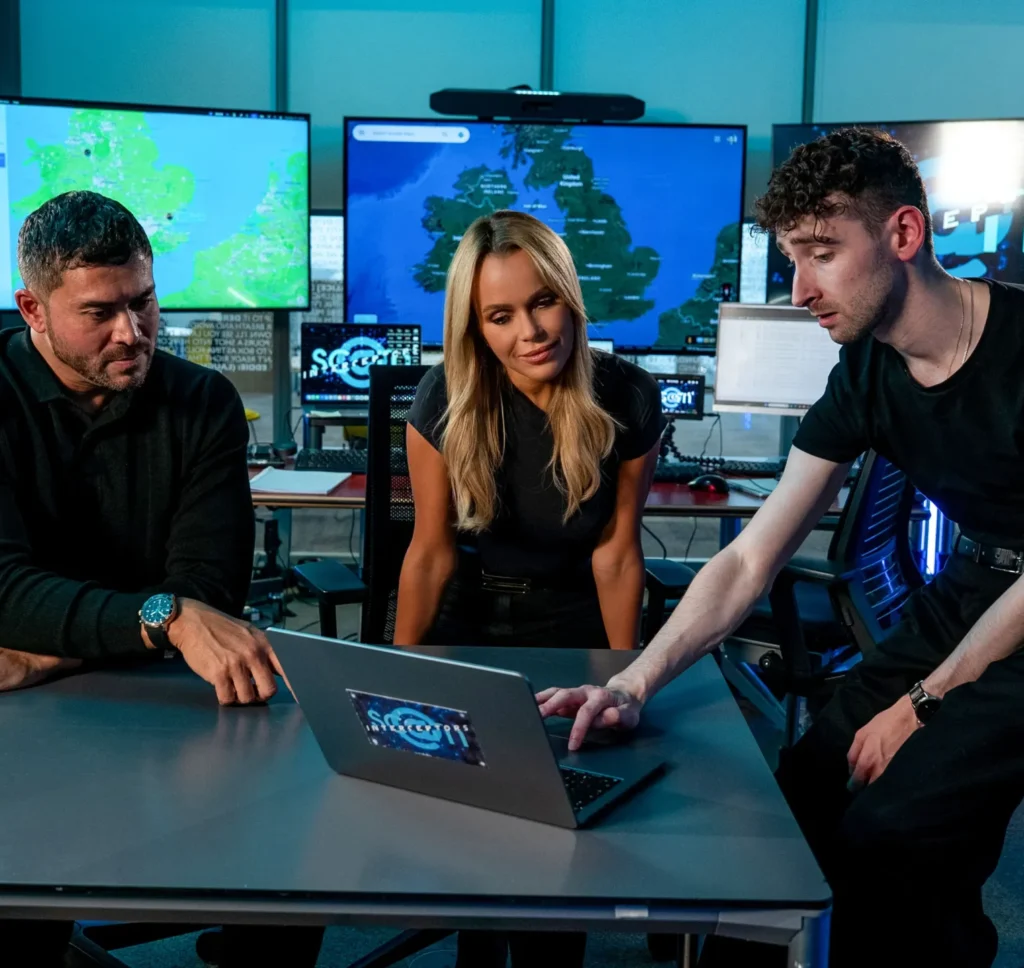
Inside the nerve centre: Amanda Holden joins the Scam Interceptors team to analyse real-time scam operations.
Credit: BBC
“Brilliantly he saw sense just in the nick of time and did not sell his home. He realised that there was no relationship with me directly,” she reflected.
“It made me realise that my profile is out there being used for all sorts of bad reasons, so I thought if I can use my profile for good, and draw attention to the week of scam programming, then that could only be a positive thing.”
Enter the tech team. In an upcoming special of the Scam Interceptors series – airing as part of the BBC’s Scam Safe Week – Holden joins forces with hosts Rav Wilding, Nick Stapleton and ethical hacker Jim Browning to tackle scammers head-on.
Using the same remote-access technology that scammers rely on, the team monitor operations in real time – then trace them and shut them down. “Scammers, consider this your warning – Amanda’s watching,” she promises.
The programme uses remote-access tools to infiltrate the scammers’ operations – essentially hacking the hackers. In doing so, the team shines a spotlight on how fraudsters are adapting to new tech. Far from amateur con artists – modern scammers are made up of individuals from international networks using sophisticated hardware and software to harvest identities, images and trust.
Holden reports that she got to meet her impersonator – dubbed “Scamanda” – and her response is visceral: “I can’t stand injustice. My family and friends say I’m always ready to fight a cause or someone’s corner, so I thought this was something I would be quite passionate about having had some recent first-hand experience.”
As for the speed of these scams? She calls it “mind blowing … how quickly money can be stolen from people’s accounts.” “I just wanted to stop them or scream at the individuals that they were being scammed,” she adds. “I realised that every minute counts and every small win is a big win.”
The stakes are high – for both victims and tech platforms that enable or fail to prevent the misuse. Holden offers straightforward advice: “Never, ever give out bank details, pin numbers or transfer money … Hang up and call into your local bank branch or call their official number on the back of your bank card.” She also warns against answering calls from unknown numbers or withheld numbers.

The dream team: Amanda Holden stands with the Scam Interceptors squad – the group using real technology to outsmart global fraud networks.
Credit: BBC
This case is a warning and a lesson. Celebrities are being co-opted by scam networks. Remote-access tools once used for support or connectivity are being turned into weapons. And identity manipulation is evolving faster than our collective defences.
It’s also a reminder that in the era of image and influence – where a face equals a brand, and a follow equals an account – fraudsters view high-profile personas as tools, not just targets. For Holden, her high profile became the bait for someone else’s trap – and she’s now redirecting it into the spotlight for good.
So, what can we do as individuals?
First: treat that WhatsApp, Instagram DM or email claiming “It’s me” with suspicion.
Second: recognise that the platforms we take for granted – video calls, remote access, identity verification – are also the tools of the malicious.
Third: and perhaps most importantly for The Modems’ audience – consider your digital presence both asset and vulnerability. Campaigns like this show celebrities aren’t immune, nor is the tech industry free of misuse.
In Scam Interceptors, Amanda Holden positions herself as a figure ready to protect the vulnerable, expose methods and give scam-operators a taste of their own medicine.
The fight against digital fraud is as much about people as it is about code. The message is bold: technology empowers both predators and protectors, and the difference lies in who wields it.
Some of the products and services featured in this article may be from our affiliate partners, which means we may earn a small commission if you make a purchase through these links — at no extra cost to you. Our editorial team only spotlights what we genuinely love and think you will, too.
4 responses to “Amanda Holden Joins The BBC To Fight ‘Romance Fraud’ Scammers”
-
… [Trackback]
[…] There you will find 8948 more Information to that Topic: themodems.com/lifestyle/amanda-holden-bbc-scam-interceptors-romance-fraud-scammers/ […]
-
I know someone vulnerable who is currently being scammed, and believes hes in a relationship with Amanda. How can we help him
-
… [Trackback]
[…] Find More Info here to that Topic: themodems.com/lifestyle/amanda-holden-bbc-scam-interceptors-romance-fraud-scammers/ […]
-
… [Trackback]
[…] Info to that Topic: themodems.com/lifestyle/amanda-holden-bbc-scam-interceptors-romance-fraud-scammers/ […]

Leave a Comment