
In the early hours of October 19 at the Louvre Museum, thieves with power tools and a lift made off with crown jewels valued at around €88 million (£76 million/$102 million) in one of the most audacious museum heists in recent memory.
The Paris prosecutor’s office reported that one suspect was arrested at Charles de Gaulle Airport, preparing to depart for Algeria, while another was allegedly bound for Mali.
RELATED ARTICLES:
I Went to CES 2025 and These Were the 7 Gadgets That Blew Me Away
Is This Tech The Future Of Jewellery?: These Bizarre Accessories Give an Augmented-Reality Beauty Experience
DNA evidence found at the scene aided identification. The crime took place in the Galerie d’Apollon – classic, priceless, exposed. Guards were evacuated, two display cases were cut, and the gang exited within four minutes, sidestepping CCTV and weak perimeter surveillance.
The museum’s own director admitted that one exterior camera was pointed away from the balcony by which the thieves entered, and many rooms lacked even a single camera.

nce dazzling under museum lights, these emerald-studded heirlooms were at the centre of the €88 million Louvre robbery – proof that even royal treasures need next-gen tech protection.
Now, picture an alternative scenario: a security system layering real-time 3D spatial awareness over the museum’s architecture and crowd flows; a system that tracked movement through laser-point clouds rather than just static video frames. In short: LiDAR-based spatial intelligence.
While traditional surveillance systems lean heavily on cameras and motion sensors – systems vulnerable to lighting changes, blind spots and crowding – LiDAR (Light Detection and Ranging) offers an entirely different dimension: laser-precise geometry, depth information and movement detection without ever documenting faces or personal identities.
RELATED ARTICLES:
Tech Expert Says AI Agents Will Eliminate Need For Apps
Wearable Tech Is the UK’s Biggest Wellness Trend
“In a heist like the one at the Louvre, 3D LiDAR could have been a true game changer – instantly mapping every movement and spatial detail in real time through laser technology,” says Outsight’s President & Co-Founder Raul Bravo, “Its precision enables it to detect both subtle changes and suspicious behavior, even in complete darkness and at a cost comparable to cameras. And because it doesn’t capture any images, it provides an inherent layer of privacy – while still being able to observe the street or surrounding areas – a crucial advantage in places that attract large crowds, such as museums.”

Cameras capture her every angle – yet even the world’s most guarded smile reminds us that legacy surveillance still has blind spots.
Pioneers of “Entreprise Spatial AI” Outsight, nails two of the major headaches for modern security: firstly, gaps in visibility (whether due to lighting, crowding or blind spots); secondly, the growing need to protect privacy – especially in public cultural venues now navigating both security and compliance (hello GDPR).
Traditional CCTV struggles in dimly-lit corners or upstairs balconies; the Louvre’s own internal audit found that one-in-three rooms in the target area were entirely uncovered by cameras. Had LiDAR been deployed around the zone of entry, you’d be looking at continuous, anonymised 3D point-clouds of every person, vehicle or item that crossed the threshold.
In practical terms, here’s how the tech works: A field of laser pulses sweeps a physical space, producing millions of points per second that map geometry in centimetre-level detail. That data feeds into Outsight’s “Motional Digital Twin” system, which creates a live digital replica of the environment: the walls, the pillars, the display cases, the balcony and even the scooters waiting outside.
RELATED ARTICLES:
Vintage Tech Is the New It-Girl Status Symbol
5 Things You Need to Know About Google’s Supercomputer
All activity is logged without showing faces. The system can flag unexpected behaviour: a ladder being raised, a balcony breach, two figures working in unison near a glass case. When correlated with existing CCTV, these alerts can reduce reaction time, isolate suspects and track exits.
On top of that, the dashboard-style interface gives security teams a bird’s-eye view of movement: where people gather, how many, their trajectories, and when something deviates from the norm. Instead of relying on a guard spotting a masked figure on camera, you get an alert when someone goes where they shouldn’t – or when a ladder appears from an unusual angle.
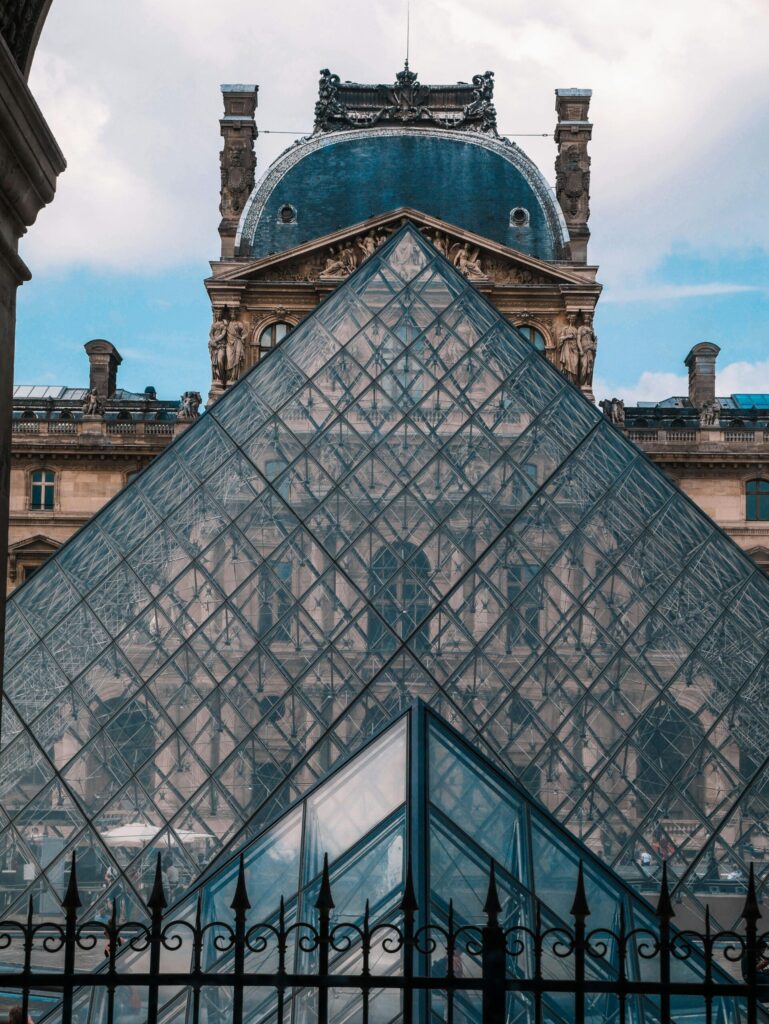
The Louvre Pyramid’s glass geometry mirrors the promise of LiDAR – millions of laser points mapping the world’s most famous museum in 3D.
The tech is already in operation across airports, transport hubs and industrial facilities in Europe, North America and Asia. Outsight’s platform is no longer theoretical; it’s real-world proven. The same logic behind monitoring pedestrian flows in an airport (where clutter, crowds and lighting constantly shift) can be applied to ultra-secure cultural landmarks.
Museums such as the Louvre are, in effect, high-value traffic hubs: visitors of all kinds, priceless artefacts, public access, narrow windows of secured zones. They need security systems that operate reliably in complex, high-density, multi-layered spaces.
From a Modems perspective – yes, we talk fashion and beauty and lifestyle, but we also love to geek out on tech, especially when it’s elegant, impactful and intersectional. Because we know that your museum trip might be interrupted by life, your smart home might tighten its sensors, and the physical world is just as hackable as your laptop. The Louvre break-in is more than an art-world scandal; it’s a wake-up call for how we protect physical public spaces in the age of digital sophistication.
Interestingly, while the heist prompted the Louvre to move its most precious jewels to the vaults of the Bank of France (26 m underground), it also prompted renewed interest in solutions that go beyond “more cameras.” Because simply adding more CCTV doesn’t fix the issues of angle, lighting, recognition, response time or privacy. LiDAR doesn’t record faces, but it does record geometry and movement. And from a privacy-vs-protection standpoint, that is a huge win.
If deployed proactively, such a system might have:
- Recorded the ladder ascent onto the balcony at 09:30.
- Mapped the two individuals cutting the display cases.
- Noted the evacuation of the guards and correlating trajectories to the scooters outside.
- Generated a real-time alert when an unscheduled exterior vehicle (the lift) arrived at the wall zone.
- And post-event, given investigators a clean, timestamped spatial map of every trajectory – which could reduce the search radius, speed up DNA matches and narrow down suspect movement.
And what’s even more relevant? This kind of tech isn’t just for museums. Think high-traffic fashion events, gallery launches, art fairs, runway show backstage zones, pop-up concept stores. Anywhere you’re dealing with VIPs, valuables, crowd flows and a need for privacy-compliant monitoring. So next time you’re at an installation or behind velvet rope, take a second to imagine the lasers quietly scanning overhead – and know that you’re part of the next-gen infrastructure.
Of course, this isn’t to say LiDAR is a silver bullet. You still need human-in-the-loop decision-making, operational governance, integration with legacy systems and a clear response protocol. And there’s always the question of cost, retrofit feasibility and cultural buy-in. But – as Outsight has shown – these systems are deployed and working. And at a time when public venues are under increasing pressure from budget constraints, regulatory scrutiny and evolving threat landscapes, they present a compelling case.
RELATED ARTICLES:
5 Best Fashion Tech Moments from AW25 Fashion Month
Naomi Campbell Invested In This Fashion Tech Start-Up
The Louvre theft was not just about jewels: it was about the intersection of art, history, security, urban design and technology. It tells a story of how legacy systems can fail in the face of agile, audacious criminals – and how next-gen tech could flip the script. For millennial women who care about safety, this tech is not niche – it’s relevant. Spatial intelligence in public spaces is the new frontier of tech that quietly protects while staying invisible.
In the end: The real win is when tech works so well you don’t even notice it. The watchful laser grid doesn’t show itself, it doesn’t interrupt your latte, it doesn’t ask for consent every five minutes – but it is keeping that tiara, that necklace, that crown from becoming dust or melted gold. And frankly, that’s pretty chic.
Some of the products and services featured in this article may be from our affiliate partners, which means we may earn a small commission if you make a purchase through these links — at no extra cost to you. Our editorial team only spotlights what we genuinely love and think you will, too.
3 responses to “Could This Spatial AI Technology Have Protected The Louvre?”
-
… [Trackback]
[…] Read More to that Topic: themodems.com/lifestyle/lidar-based-spatial-intelligence-could-have-protected-the-louvre/ […]
-
… [Trackback]
[…] Read More on to that Topic: themodems.com/lifestyle/lidar-based-spatial-intelligence-could-have-protected-the-louvre/ […]
-
… [Trackback]
[…] Find More Information here to that Topic: themodems.com/lifestyle/lidar-based-spatial-intelligence-could-have-protected-the-louvre/ […]
Leave a Comment